Attorney Matt McHugh who prepared the proposed drilling ordinance was quoted as saying that “there are no known deposits of natural gas or oil in any of the three townships…” Until someone actually makes a producing well, deposits are termed “undiscovered” but that does NOT mean they aren’t known to be there. Back in 2011 the USGS did a study of the South Newark Basin Shale formation which included data from one well never put into production. James Coleman, a researcher for the U.S.G.S said, “We think there’s a 90 percent probability that there’s gas in the South Newark Basin and that gas is between 363 billion cubic feet and 1,698 billion cubic feet.”
Coleman was speaking to Susan Phillips of State Impact who wrote an excellent article you’ll find on the StateImpact site. I’d say the odds are only slightly less than a sure thing that somebody will want to drill in Bucks if given the opportunity.
Notes from the 7/7/15 Briefing at Newtown Friends Meeting
“Attorney Matt McHugh of Grim, Biehn and Thatcher in Perkasie said the ordinance [to create an gas & oil fracking zone in Wrightstown, Newtown Township and Upper Makefield] will likely be voted on by all three governing bodies in the next month or two.” (front page news, Bucks County Courier Times 7/7/15)
Tonight 70 people gathered at the Newtown Quaker Meeting to hear about this proposed ordinance. Some key points emerged:
Outrage that no public comment has been invited
FHA lending guidelines prohibit financing for homes within 300 feet of a property with “an active or planned drilling site;” homeowner’s insurance mandated by lenders may exclude properties with a gas lease or a gas well; mortgages can be denied because of drilling on a neighbor’s property
Most of the water in Lower Bucks County is drawn from aquifers, which once contaminated by fracking fluid leaks, spills, overflows or surface runoff can never be recovered. As one woman said, “You can get energy from other sources, but you can’t live without water. Our property [in Wrightstown] would be worthless.”
The average water use for a single fracking well is 4.4 million gallons, only 15% of which is recycled fracking fluid
Spent fracking wells continue to degrade and leach forever
Oil and gas jobs and money are boom-and-bust, but the costs to the community last forever.
There is no reason for urgency in passing an ordinance. Most of Bucks County is already covered under the Delaware River Basin Moratorium until January 1, 2018. There’s no pressure to act in haste on the proposed ordinance.
After the meeting at the Newtown Quaker Meeting, about 100 people attended the Newtown Township Planning Board meeting. At the end of the public comment period, the Chairperson urged us to communicate with the Township Supervisors who have the power to make the final decision.
ACT NOW
Come to the Newtown Township Supervisor’s Meeting on , July 8 at 7:30pm and voice your opinion
Can’t attend? Make a phone call (215-968-2800 ext. 8, then ext. 3 to speak with Olivia Kivenko, Administrative Assistant to the Town Manager) or write a short, handwritten note to Newtown Township Supervisors, 100 Municipal Drive, Newtown, PA 18940 and say we want at least a one-year study period with public participation before any gas & oil drilling ordinance is considered for a vote
Attend, write, call the Wrightstown Supervisors (meetings on the 1st and 3rd Mondays of every month at 7:30pm, 2203 Second Street Pike). Ask Wrightstown to withdraw their request for an ordinance to create a gas and oil drilling zone.
Check the coverage in the Bucks Courier-Times (you may need to subscribe ($1 promo), to see the whole article.)
Zoning is seldom easy. Those who must decide about land use are usually picking winners and losers and it’s certain that someone will get hurt and go away mad. The stress is usually made tolerable by a shared vision of a community that’s pleasing, healthy and safe to live in with economic prosperity for all. But a Fracking well is not like a water well. Fracking poses real danger and not just the ordinary nuisance or aesthetic issues that land use schemes normally address. Big money is in play and Planing Boards and the Supervisors they advise are confronted with pressure from many sides.
Can’t be Banned
This decade has seen a battle between large gas and oil drillers and local communities. There was the disaster of Dimock, PA that drew national attention and was the subject of the film Gasland. The PA Legislature passed Act 13 (2012) stripping local municipalities of zoning control over fracking. Several municipalities sued and the PA Supreme Court ultimately declared that all municipalities have a duty to protect “clean air and water” and to preserve “natural, scenic, historic and esthetic values of the environment.” But according to Tracy Carluccio of Delaware Water Keeper, “Fracking can’t legally be totally banned …”
It’s Not Pretty and It’s Not Safe
Few, if any, of our officials are experts on fracking methods and practices. Nor are they familiar with the dangers. Indeed, some health hazards like increases of Radon gas are just now being measured and documented. The US EPA study on fracking and water quality raises far more questions than it answeres.
Of 1071 of the chemicals known to be in fracking fluid, only 60 were included in the study.
The selection of the 60 out of the 1073 identified fracking chemicals was based on a number of criteria. Most were excluded because there was no standard of toxicity established for them. In other words they did not know how toxic most of the fracking fluid ingredients were, so they made a list of them and put it in an appendix to the study. Admitting that “hazard evaluation could not be conducted,” they simply noted that these should be evaluated in future studies.
EPA only studied a subset of those few chemicals on which they had toxicity information.
Those who only read the Executive Summary might miss the key fact: they were only talking about 60 chemicals out of more that 1000 possible pollutants. The other potentially hazardous stuff they found was simply listed and left as an open question. The study points out that the technology is still evolving, the ingredients used are secret, and that innovation changes the brew more or less continuously.
Too Many Unknowns
Is it reasonable to think that our municipal officials are up to the task of sorting all this out? There are still too many unknowns. Regulation and enforcement becomes a technological quagmire. If a spill happens, how serious is it? What response is needed? Do you require test wells and monitoring? What do you monitor for? How do you remediate? What are acceptable levels? If you knew that your water was tainted with one or more of 1000 chemicals not known to be safe, would you let your kids drink it?
What we don’t know can kill us.
Sacrifice Zone?
Someone suggested that large tracts already blighted by something like a quarry might be zoned for drilling thus satisfying the state’s mandate not to ban fracking, but still keeping it as far as possible from people. If air and water respected property lines this might seem reasonable. But they don’t.
Groundwater travels many miles under the surface. Whatever is released into the air moves with the wind. There is growing evidence that a buffer of thirty miles may not be enough. Among the concerns are low birth-weight babies, birth defects, and increased respiratory disease (see Links page for reports). These are like the canary that miners once used in mines. The bird succumbs before the less fragile miners sense the presence of the suffocating methane. Problems in pregnancy are, like the dead canary, a warning not to be dismissed.
This illustration shows how fluids can migrate where a well penetrates the earth. (US EPA)
The above illustration shows how a fluid, including vapors and gasses, can migrate along a well casing. Note that the casing goes down to the shale layer and then turns horizontal. These horizontal well casings can be bored to extend one, two and even four miles from the vertical shaft. They can radiate from a site like spokes of a wheel. Half a mile down, out of sight, gas wells cross property lines and even municipal boundaries.
When a house is built, the municipal building inspector can and does hold up construction until he/she can inspect the footers, the framing, the plumbing, the wiring, and so on. With a well there is no such opportunity. If it’s done wrong you can’t really tell – at least not until the damage becomes evident from the surface. How do you proactively regulate that? What does the municipal code official know about fracking wells?
Fracking is a Big Deal
A drilling zone is not just a routine land use issue. Business as usual will not suffice to protect the public and preserve our quiet enjoyment of hearth and home. The presence of a fracking operation anywhere in Bucks County can affect much more than the neighborhood or town; everything downwind and downstream can be compromised. In addition fracking brings traffic that pulverizes roads, pipelines that slash through neighborhoods, emergencies that first responders are not prepared to meet, and a deteriorating bore hole that can allow nasty stuff to creep up into the shallower levels of strata and even the water table. For the drilling company, these are all “externalities.” They aren’t part of the expense model. They are left for the municipality to deal with.
The municipal supervisors are tasked to zone, regulate and police all of these fracking complexities for our common benefit. The State? It took a Supreme Court decision to get back any say in the matter at all. And the Pennsylvania legislators seem unwilling to limit the gas industry because of the money it promises. Enforcement of State regulations may depend on the politics of the current Governor.
The drilling moratoriums expire in 2018. Gas prices are low enough to ease drilling pressures. So we are in the lull before the storm. Even so, I don’t envy our officials as they grapple with these matters and try to remain true to their charge to protect our air, our water, our environment … and our lives.
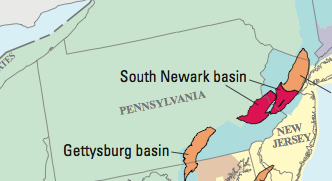
There is a moratorium on drilling until 2018 in our area. Until it ends there won’t be any drilling in Bucks County we are told. But two years ago in June 2013, “the U.S. Geological Survey released a report estimating the South Newark Basin could yield between 363 billion cubic feet and 1,698 billion cubic feet of natural gas,” according to Katie Colaneriwriting for NPR. That’s the prize and the answer to the question.
Screenshot from the U.S. Geological Survey The South Newark Basin stretches from New Jersey down into Bucks and Montgomery Counties. (NPR)
Shortly after thatUSGS Report the State of Pennsylvania funded a study of gas drilling in Bucks and Montgomery Counties. The contract was slated to end on June 30, 2015, so the results will be known well before the moratorium ends. The savvy executives of energy companies are certainly not sleeping, and are very aware of the opportunity.
Bucks County is close to markets and transportation for the gas and it has existing pipelines, albeit rather old ones, in the area. If you make your money extracting gas, what’s not to like?
Well there is the local reaction to think of. Zoning could get sticky. But if you make all the right moves you can avoid the pitch forks and barrel staves.
The Pennsylvania Association of Township Supervisors (PSATS) described the impact of drilling on affected communities in their 2015-16 Policy Statement as follows:
Townships feel impact
Formerly quiet townships have been
transformed by the drilling industry. Small
rural roads that once carried a few dozen
cars a day have become the site of daily
traffic jams, the result of hundreds of
heavy water-filled tanker trucks for frack-
ing, stone trucks for site development,
and pipe and drilling rigs transporting the
needed equipment to the often mountain-
ous and rural sites. Local and state roads
disintegrated under the weight of the
loads, at times within days, if not hours.
Out-of-state workers for the drilling
companies competed for rental proper-
ties and hotel rooms, escalating housing
costs and displacing tourists. Emergency
responders faced new challenges without
needed equipment or training. And resi-
dents expressed concern over the future of
their water supply.”
The article applauds the $600 million in “natural gas impact fees” of which 60% was passed through to municipalities to help offset the damages. While the article is generally upbeat and positive about the economic benefits of the gas industry (jobs, higher wages, royalties) it avoids discussion of health and environmental issues. The photographs of drilling sites are impressive and interesting, but few would want to be viewing them from a bedroom window. One can’t help wonder if the writer was trying to put lipstick on the proverbial pig. (Read the full article here.)
“In the past four years, the number of peer-reviewed studies on shale drilling and fracking has gone from almost zero to more than four hundred, according to the Physicians Scientists & Engineers for Healthy Energy public database. That’s a lot of data, with topics including health impacts, air pollution, water contamination, seismic impacts (including earthquakes), wastewater, engineering issues, climate impacts, and economics.
Dimock, PA fracking site. Dimock’s well water was contaminated with dissolved methane. Details at http://stateimpact.npr.org/pennsylvania/tag/dimock/
And the overwhelming consensus from this thorough, objective, independent and rigorous analysis is that fracking has serious dangers and the best course of action is to prohibit fracking.” ~ Larysa Dyrszka, MD and Mary Menapace, RN … (read more)
The harmful effects of fracking have been exhaustively examined by very competent experts. New York State concluded that the risks and costs were too great to permit fracking. Here is the text of an official press release
“After years of exhaustive research and examination of the science and facts, prohibiting high-volume hydraulic fracturing is the only reasonable alternative,” said Environmental Conservation Commissioner Joe Martens in a statement today. “High-volume hydraulic fracturing poses significant adverse impacts to land, air, water, natural resources and potential significant public health impacts that cannot be adequately mitigated. This decision is consistent with DEC’s mission to conserve, improve and protect our state’s natural resources, and to enhance the health, safety and welfare of the people of the state.”
The Findings Statement concludes that there are no feasible or prudent alternatives that adequately avoid or minimize adverse environmental impacts and address risks to public health from this activity. [emphasis added]
DEC based the Findings Statement on the vast research included in the Final Supplemental Generic Environmental Impact Statement (FSGEIS) released last month. The FSGEIS included consideration of extensive public comment and the state Department of Health’s Public Health Review, which concluded there is considerable uncertainty as to potential health impacts from HVHF and that HVHF should not move forward in New York State.
The Findings Statement is the culmination of the environmental review process to fully evaluate the environmental impacts of this activity. The Findings Statement details the widespread potential impacts from the HVHF process, including impacts to water and air resources, ecosystems and wildlife, community character and public health.“
The language of the proposed ordinance lacks teeth and provides a huge amount of wiggle room. In my opinion, as a former business owner, it’s actually quite favorable to a driller – that is unless he’s encumbered by high principles and scruples. I’ve marked up the linked copy to highlight specifics. Before discussing these, let’s look at the context in which they will come into play.
Financial Responsibility
The driller is likely to be a limited liability corporation (LLC). This means just what the name implies. The corporation exists to shield its owners from otherwise unlimited liability for the risks of the business. The street savvy owner can pour just enough money into the LLC to conduct operations. When things go wrong, the LLC can be allowed to go bankrupt. But if things go well, the cash generated flows to the owner(s). Banks know this and they generally require the owners of such a business to personally co-sign for loans.
The municipalities and the public has no such protection. Even if Exxon-Mobil, with its vast resources were backing the LLC it would be extremely difficult if not impossible to collect more than the assets of the drilling LLC. Financial responsibility is thus a really big concern. The proposed ordinance has provisions for a bond ($50,000) and unspecified liability insurance, but neither of these is sufficient protection considering the massive risks and likelihood of leaks, spills, and fires.
Enforcement
There is always expense involved in enforcement. With an operation like well drilling and fracking, much of the work is conducted out of sight using practices and procedures unfamiliar to regular code enforcement personnel. Violations can easily go undiscovered until irreparable harm has been done and/or a disaster brings them to light.
The proposed ordinance has a lot of language that requires subjective judgment. You can bet that a driller will insist on the most lenient and cost efficient interpretation. It will be up to the enforcing authority to decide if they wish to spend the money to litigate. Litigation is a slow and deliberate process with many opportunities for delay and diversion.
Click to View or Download the proposed ordinance.
The court docket’s always crowded, and the best lawyers bill their time $300, $500 or more an hour – and yes, you do need that level of talent when stakes are high. Justice has a very high price, even if you are the government.
The document
I recommend that you see for yourself. But here are my observations and objections:
The “standards” are vague and invite litigation.
The language relies on PA and Federal regulations that have failed to protect others in our state.
The setbacks for operations are only 100 feet. Some of the trucks used in these operations are nearly that long (70 feet).
Drilling can create permanent pathways for migration of toxic material (arsenic, radon) outside the well casing. Once drilled and fractured it can’t be undone.
The documents propose a 15 acre minimum tract. Wells commonly are drilled with multiple branches extending out 1 or 2 miles from the well site. They can resemble spokes of a wheel where the vertical well shaft is the axle and horizontal branches radiate out. There even can be such “wheels” at a second level. The fracturing begins near at end of the each branch.
Fracking uses huge volumes of water. Fresh water is combined with “trade secret” toxic chemicals and fine sand (also toxic) to make the injection fluid. After fracturing much of this is ejected, followed and combined with “produced water” or brine from the shale. Where the geological formations permit, these fluids are dumped into deep disposal wells. Such wells are associated with seismic activity (earthquakes), and much more rarely, so is fracking. It may not be possible to show direct cause and effect in an individual instance. Indeed, advocates of fracking insist that the geometric increase in the number of quakes is mere coincidence. Not much help when the foundation of one’s home is cracking.
The staging and rapid handling of the large volume of toxic fluids, produced brine, chemicals, and dusty sand make spills almost inevitable with the probability of surface water contamination. Storm water management is a problem. Open retaining ponds are a source of air pollution.
The logistics require thousands of heavy truck trips over roads to and from the well site greatly increasing maintenance costs, and creating major inconvenience and traffic hazards.
Although the proposed ordinance seeks to regulate the hours of operation, the pressurized fluid in the ground does not respect such intentions. Some extraction equipment may, of necessity, operate 24/7. At currently operating drill sites it is always 24/7.
Oil and gas wells leak methane and other gasses. In fact, research shows that the leaks wipe out the principal advantage of natural gas as a clean-burning fuel. The unburned methane that leaks is many times more damaging than the carbon dioxide of combustion.
The limitations of sound levels are well intended, but meaningless. Loudness is a subjective perception that is relative to ambient sounds (birds, crickets, leaves rustling). When one is enjoying the stillness of a country evening, the smallest sounds carry miles. The measurement would presumably be made at the boundary of the site. The “45 decibels” specified is equivalent to the ambient sound level in a home. But a diesel truck at 100 feet is 70 decibels and measured at curbside it is 80 decibels. There will be continuous diesel traffic. These noises measured at the source of the noise it would be exponentially louder. Terrain and environmental conditions can cause sound to travel great distances with intermediate “dead” zones. Obviously it is very difficult to regulate noise pollution.
A well head or pipeline fire is beyond the training and equipment of local firefighters, yet it is a real risk.
Once water supplies are contaminated complete remediation in nearly impossible.
The smells and toxins in airborne pollution drift miles from the drilling site.
There’s more, but this captures the essence of the criticism. One telling aspect of the proposed ordinance document is the fact that the specifications for the chain link fence for the site are more lengthy and detailed than the noise or pollution provisions.




You must be logged in to post a comment.