Category: Uncategorized

  • Letter to the editor: Fracking’s destruction

    Here is an excellent letter posted to western Pennsylvania’s “Trib Live”

    Tribune-Review

    Tribune-Review  | Saturday, May 17, 2025 5:00 a.m.

    Contrary to industry cheerleading, gas is not a better energy option than other fossil fuels. Fracking destroys agricultural and forest land, pollutes air and water and poses serious risks to public health, e.g., seven times the risk of lymphoma and a 20% increase in hospitalizations for children with asthma.

    Increasingly, Pennsylvania residents don’t want these industrial operations near their homes, schools or churches. The letter “We need truth on air quality” (May 6, TribLive) challenged area air monitoring results that indicated poor air quality because, the writer noted, some monitors were placed near frack operations. However, approximately 1.5 million Pennsylvania residents live within a half-mile of oil/gas wells, and millions more near compressor stations and processing facilities. A perhaps unintended message was that Pennsylvania residents get it, fracking is a dirty business.

    The letter “Data center concerns, opportunities” (May 2, TribLive) supported the proposed Upper Burrell AI site because it will provide its own energy. However, “its own energy” will come from six on-site fracked well pads. All of this is a real concern as research continues to indicate serious health concerns, as violations mount (roughly 25,000 since 2008), and unplugged frack wells are abandoned (171 to date) with plugging expected to cost up to $8.5 billion.

    The Trib has reported on local action on zoning ordinance restrictions for solar and wind sites. Is the same consideration being given to frack sites which pose real risks to the land and residents? If not, why not?

    Jan Milburn

    Ligonier
  • Fracking Economics

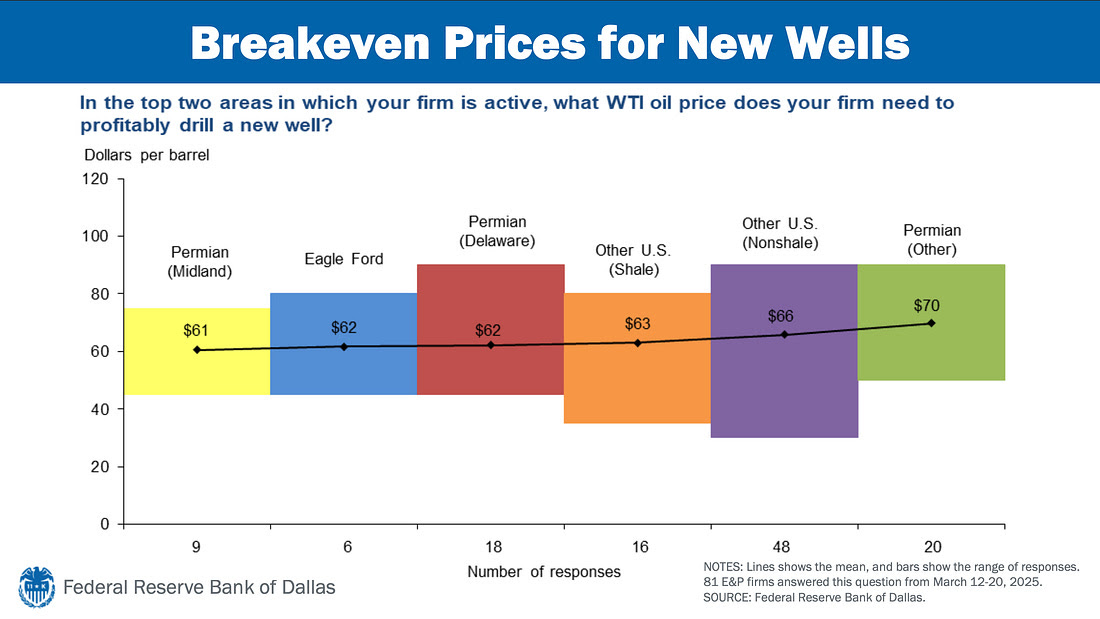
    Paul Krugman’s 5-13-25 column provides a key insight into the relationship between renewable energy and fossil energy. Renewables are competitive, even when we don’t take into account the hidden subsidies society provides fossil fuels by tolerating the externalized environmental damage. If a driller can’t get at least $60 a barrel for oil produced, it doesn’t pay to drill. Gas has a similar threshold of profitability. So when the energy industry waxes poetic about the benefits of drilling, look for the dodge and the gimme. The driller needs a premium price for the energy he mines. And the cost of renewables will continue to drop.

    Here’s a quote from Krugman’s article:

    In the case of shale, it’s all about prices. Drilling new shale wells is expensive. In fact, Trump’s vision of drastically lower oil prices never made any sense, because any large drop in oil prices would make new shale wells unprofitable. And since production from any given shale well drops quickly over time, anything that caused new drilling to fall substantially would quickly translate into declining oil production.

    How low would prices have to go to shrink the U.S. oil industry? Recently the Dallas Fed did a survey which suggested that drilling in many major fields would stop if the price per barrel fell below the low 60s:

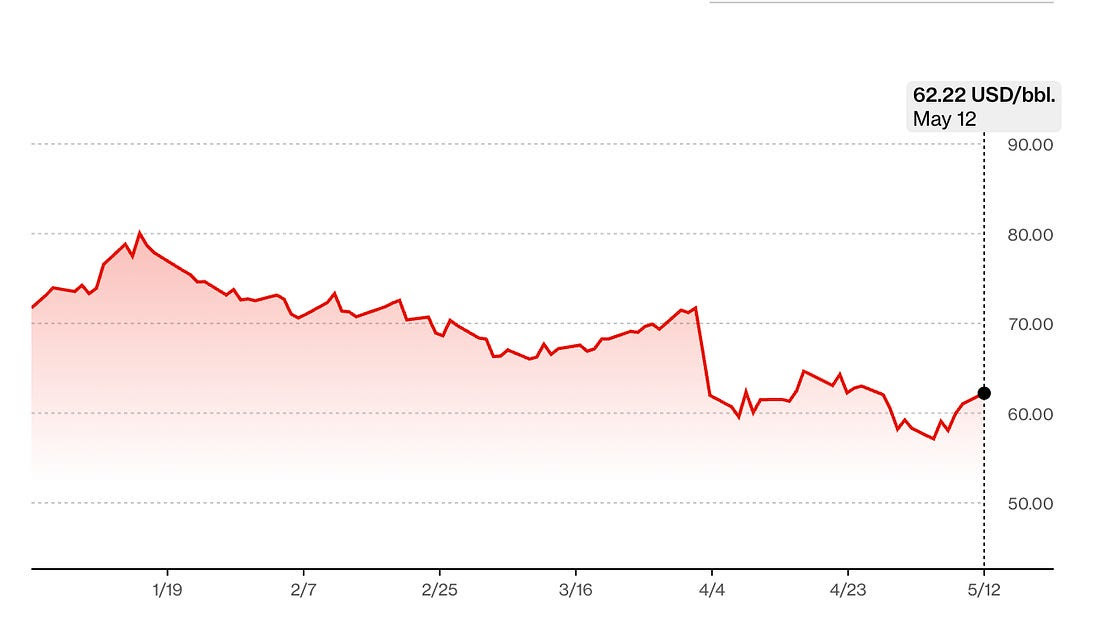
    And that was before Trump’s tariffs raised costs, so the critical price is probably higher now. And guess what: oil prices right now are at a level where we can expect production to fall. Here are oil futures:

    Source: Bloomberg

    Why did oil get cheap? Look at the sudden drop on April 2, aka Liberation Day, when Trump first announced extreme tariffs. It’s obvious that oil prices are down thanks to pessimism about the global economy, which in turn is tied to Trump’s trade war. And by the way, that war is by no means over. A new analysis by the Yale Budget Lab finds that the damaging effects of Trump’s tariffs are only modestly mitigated by his surrender to China.

    And as for renewables: Trump hates them, wind power in particular. He offers crazy justifications for that hatred — did you hear about his claim that offshore wind farms kill whales? — but it’s pretty clear that he has been nursing an irrational grudge ever since he was unable to stop a Scottish wind farm that he thought ruined the view from a golf course he owns.

    Oh, and I’m pretty sure that MAGA types in general dislike renewable energy because they don’t consider it manly.

    So what will be the economy-boosting effects of drill, baby, drill? Nil, baby, nil.

  • Sunset of Fossil Fuel?

    Midnight Oil

    While oil companies continue to extract petroleum from the ground, taking a step back, the health of the carbon extraction industry is not particularly strong. Since 2021, the 5 largest independent oil majors (Exxon, Chevron, Shell, BP and Total) have been in the habit of sending more money back to shareholders than they are developing new business. This is a sign that the corporate brass is less interested in the long-term future of the firm than in extracting value from the present. Even more interesting is the oil majors’ reserves, which in many cases are depleting to less than 10 years: BP has 7.2 years of reserves left, while Chevron has 8.03 and Shell has 9.27 years. Exxon Mobil (12.4 years) and Total (12.6 years) are the only firms that have more than a decade’s worth of juice in the ground, which implies that the business is a sunset industry.

    David Fickling, Bloomberg as quoted in NumLock news.

    They remain a corrupting influence on US politics, and a threat to environmental sustainability.

  • Who Will Protect the Public Interest?

    Fracking does nothing to improve the landscape, the roads, the air, the water, or the lives of the locals. And energy companies are devious and without honor in these matters. Who will safeguard the parks?

  • Climat News

  • Wastewater Pipelines Unregulated

    What could possibly be wrong with leaving the safe operation of fracking wastewater pipelines to the folks who produce this toxic pollutant? Of course, that question is facetious. Unaddressed leaks reduce the amount of toxic waste for disposal. Legal remedies for damage are costly to achieve. So, the downside risk is limited if nobody is actively policing the operation of the pipeline. But the expenses of inspection and maintenance come right off the profit line of the operator. What could go wrong indeed!

  • Yes, Ban It

    We are happy to discover some good news about fracking: New Your State has banned CO2 fracking. There’s grumbling about lost economic opportunity, but keep in mind that all of the long-term costs are deferred and externalized. So it’s “other people’s money” that must deal with the health effects, the pollution, and the long chain of expenses related to climate change. The economic opportunity is an illusion cultivated by the energy lobby.

    Unfortunately, Pennsylvania has not awakened to the realities. Taxpayers subsidize fracking in so many hidden ways. Fracking does nothing good for locals or the planet.

  • Seasonal Direct Action

    “Direct action” is the term that is used to describe protests. Some are benign, like the caroling against fracking described below. Others are disruptive and seek to get in the way of business as usual to bring attention to the issue being protested. Direct actions become more extreme when the stakes are high and civil remedies for injustice are frustrated. Let us hope that direct action, even benign protest, is not necessary to prevent the excesses of the energy industry.

    This group will be caroling — but with pointed anti-fracking lyrics.

  • Drill for Geothermal?

    We would all welcome the use of drilling technology that did no harm and left fossil fuels in the ground while tapping the always-on heat stored in Earth’s core. But, even if we aren’t fracking, and we don’t intend to produce gas or oil, I’m skeptical that we are capable of punching holes through the aquifer without creating paths for nasty stuff to migrate. Though I’m less sanguine than the authors, here is the hopeful article.

  • Still Too Many Who Favor Fracking

    As we reel from the ravages of two major hurricanes, and anticipate more and worse, there are still those among us who disbelieve the dire warnings of science. Will we learn to “keep it in the ground” soon enough to save our children?