That oil and gas interests might be reluctant to accept information pointing to the end of the fossil fuel era is completely understandable. But the just released report by the Union of Concerned Scientists titled The Climate Deception Dossierdocuments decades of deliberate deception aimed at sewing doubt in the media and the public’s perception of climate science. The report reveals industry internal secret documents that prove there has been a strategy to hide the truth. It’s little wonder that so many politicians today find it easy to deny the opinion of 97% of the scientific community. They’ve been blinded by money and duped with lies.
Proof of decades of deception by fossil fuel industry: Union of Concerned Scientists.
I can’t improve on the summary that appears in the summer issue of UCS’s journal, so I urge you to read it for yourself and then browse through the report that it announces. Although those few who have been close to the issue for years knew of various elements of the deception, the strategy was largely successful and history may yet look back upon the years since 1988 as the beginning of society’s greatest and most disastrous propaganda lies.
For those who follow NoFrackingBucks.net there is a disturbing confirmation that the oil and gas industry is ruthless and unrelenting in its hunger to expand regardless of the cost to society and future generations. Although our focus is very local, the menace is global and it will touch everyone – especially the poorest and most vulnerable nations.
We must consider both actions and words in weighing arguments about fossil energy. On the fracking issue, the industry has gotten legislation to exempt itself from regulations aimed at protecting the environment, and has succeeded in getting other legislation that severely limits the ability of local government to protect municipalities from the ravages of gas and oil extraction. These self-serving legislative campaigns are perverse and destructive. The deception and amoral (some might say psychopathic) campaign to discourage society from acting prudently in the face of a clear danger is a disgrace. If you agree, take the time to phone your state representatives and your US senators and congressman. Tell them to read the evidence and see for themselves how we all have been duped. Demand that public policy reflect climate reality.
Because the fracked cracks can extend some 2,000 feet above the well bore hole, wells that lie less than a mile (5,280 feet) below the surface pose a higher risk for water contamination. According to Stanford University scientist Robert Jackson:
“Not all shallow wells pose the same threat to groundwater. The “riskiest” fracked wells are both shallow and use high levels of water—1 million gallons or more, said Jackson. Studies have shown that when these high-pressure wells fracture the bedrock, the cracks can extend as much as 2,000 feet upward. This provides an opportunity for the chemical-laced water used in fracking to migrate to the shallower depths of the water table. And the smaller the gap between drilling and surface water, the greater the chance of interaction.”
Water in eastern Bucks is supposed to be perched atop bedrock that lies between 100 and 250 feet below the surface. Sampling a few records in the domestic well database I found wells drilled to depths of 500 feet below the ground level in Wrightstown, and 300 feet in Newtown Township, but the ups and downs of local terrain influence the depth relative to the geological data. Some of the drillers reported drilling through bedrock at less than 10 feet. Some wells are for withdrawal of potable water, others are used for geothermal heat.
Most of the aquifer is recharged by infiltration from the surface and nearby streams and the Delaware River. The shale gas layers that have fair to good gas potential begin at 3,000 feet. Simple math says that hydraulic fracturing could reach to within 500 feet of layers reached by domestic water wells. One can’t know, of course, what natural fissure and cracks may exist in the bedrock that might provide pathways for fracking chemicals pumped into the ground at 9,000 psi to find there way upward. But the notion that “miles of bedrock” lie between the fracked layer and the water layer simply is not true in the Newark Basin.
Given the poor record of the gas and oil drilling industry for predicting or preventing leaks, it would seem very risky to do shallow fracking. If it were to be allowed, there should be mandatory independent monitoring of groundwater quality utilizing test wells near the drill pad. Equally important there must be substantial financial bonding and insurance requirements to fund remediation should methane or fracking chemical contamination be found.
One of our contributors discovered “Explore a Fracking Operation – Virtually” – a website that lets you see photographs of the various stages of fracking operations. Those who have not traveled to the regions where fracking is done may be surprised at the scale of this industry. Well drilling and fracking requires hundreds of heavy vehicles and a logistics reminicent of a large scale military mobilization. Check it out by clicking the illustration below:
Screenshot of FrackTracker Website.
You will find another excellent website at R-CAUSE.net. Like this site, it seeks to inform its constituency about the risks of fracking. Although New York has banned fracking, there continue to be threats to water and air in the Rochester and Corning areas.
No one can or will guarantee that a gas well will never leak. You can find industry video narrated by one of those deep Walter Cronkite-like voices that tell you about the extraordinary precautions drillers take to protect the aquifer from migration of nasty stuff between layers.
You can even cherry-pick to find industry statistics claiming that leakage is very rare, less than one percent (not true). But you won’t find anybody putting their money on the line that the well they want to drill into your aquifer won’t someday spoil your well water.
You will find that extraordinary measures have been taken to shield drillers from liability and regulatory culpability. Exemptions have been carved out of the body of law intended to protect the environment. You will also find plenty of examples where the industry has obtained gag orders and non-disclosure settlements hoping to keep a lid on public knowledge of mistakes. There are even some egregious examples of perverse use of baseless law suits and even phony criminal charges to discourage public participation showcasing problems with drilling. As the cops say, “you can beat the wrap, but you can’t beat the ride.” (The “ride” is the whole process of being arrested and charged.) Even if one is obviously innocent of doing wrong, legal defense is costly and even if you win you end up out-of-pocket.
What’s behind all this? Independent peer-reviewed studies as well as industry studies show that at least six percent (6%) of fracking wells leak early in their life cycle. I strongly suspect that all wells will leak eventually – maybe not in 10 or 20 years, but in 100?
Let’s stick with what we know for the moment. Drilling puts a large hole through half a mile of ancient rock formations to reach the gas rich layer under Bucks County. It’s deeper elsewhere. At the surface level, where the aquifer is, at least three concentric steel casings line the bore hole. Cement under pressure is forced into the space between the outer casing and the rock to prevent gas and/or liquid from traveling vertically outside of the casing and moving between geologic layers. This cement is supposed to keep the nasty stuff out of the drinking water layers.
This is the fundamental weakness of the drilling system. Think about the cement you see in sidewalks, driveways, and foundations. It cracks. Cement is rigid and very strong in compression, but it doesn’t have good tensile strength. It doesn’t necessarily bond permanently to other materials. Voids, where there is no concrete seal, may be left when concrete is pumped into the annulus or gap around the well casing. It’s not like the footing for a house; you can’t look and see. Even with no disturbances cracks can open as the cement cures or long after it’s fully set. But there are disturbances. Seismic events happen regularly. The earth moves.
The drilling process itself involves huge rotating drill bits that pound and vibrate to chip the rock and open the hole. Boring generates heat that is carried away from the bit by the flow of drilling mud, a wet slurry pumped down the drill pipe bathing the cutting bit and carrying the chips and heat back up and out. So there is are temperature changes. Steel and cement don’t expand at the same rate. Drilling itself vibrates the upper casings components and the earth as the bore hole is extended downward. Time is money and sometimes drilling operators don’t wait long enough for the fresh cement to cure to full strength, fracturing the “green” cement as they resume drilling. Rust forms on the mild steel casings as dampness, chemicals, and natural acids do their work. The annulus space outside the casing isn’t clean. All of these conditions act to break the bonds between the casing and the cement, and loosen the cement from the bore hole walls.
Repeated fracking cycles subject the casing and the cement seal to strain. It’s hard to imagine that a steel pipe half a mile long doesn’t flex and move under these extreme pressure changes. The same hydraulic forces that are fracturing rock where the lateral pipe is perforated are also trying to fracture the seal around the well casing. Blowouts sometimes happen.
The casings come in sections and thread together. For more than fifty years the joints have been a problem when put under pressure. Engineers have optimized the shape an pitch of threads and used sealants. In spite of considerable experience and ingenuity, casing joints still fail.
Then there is outright reckless disregard for the consequences of leaks. Drillers have paid huge fines and settlements for blatant disregard for good practice and regulations. Critics say that inspection and enforcement is understaffed and too lax. Drillers sometimes even refuse to allow inspectors onto the drill site.
None of the precautions taken by even the most ethical drillers can ensure that a bore hole once created can be sealed permanently. Consequently every new well increases the probability of contamination of the aquifer forever. That probability starts with the first well at one-in-twenty odds (1:20) and the odds get worse over time. Each new well adds another leak possibility. It’s like playing repeated rounds of Russian roulette first with one gun, then two, and so on.
This is not a game we should want to play. The more I know about fracking, the more it looks like a bargain with the Devil. No matter how appealing the cheap energy is, in the long run we lose.
[revised for clarity and to update links 7/10/15, 7/11/15.]
Attorney Matt McHugh who prepared the proposed drilling ordinance was quoted as saying that “there are no known deposits of natural gas or oil in any of the three townships…” Until someone actually makes a producing well, deposits are termed “undiscovered” but that does NOT mean they aren’t known to be there. Back in 2011 the USGS did a study of the South Newark Basin Shale formation which included data from one well never put into production. James Coleman, a researcher for the U.S.G.S said, “We think there’s a 90 percent probability that there’s gas in the South Newark Basin and that gas is between 363 billion cubic feet and 1,698 billion cubic feet.”
Coleman was speaking to Susan Phillips of State Impact who wrote an excellent article you’ll find on the StateImpact site. I’d say the odds are only slightly less than a sure thing that somebody will want to drill in Bucks if given the opportunity.
Notes from the 7/7/15 Briefing at Newtown Friends Meeting
“Attorney Matt McHugh of Grim, Biehn and Thatcher in Perkasie said the ordinance [to create an gas & oil fracking zone in Wrightstown, Newtown Township and Upper Makefield] will likely be voted on by all three governing bodies in the next month or two.” (front page news, Bucks County Courier Times 7/7/15)
Tonight 70 people gathered at the Newtown Quaker Meeting to hear about this proposed ordinance. Some key points emerged:
Outrage that no public comment has been invited
FHA lending guidelines prohibit financing for homes within 300 feet of a property with “an active or planned drilling site;” homeowner’s insurance mandated by lenders may exclude properties with a gas lease or a gas well; mortgages can be denied because of drilling on a neighbor’s property
Most of the water in Lower Bucks County is drawn from aquifers, which once contaminated by fracking fluid leaks, spills, overflows or surface runoff can never be recovered. As one woman said, “You can get energy from other sources, but you can’t live without water. Our property [in Wrightstown] would be worthless.”
The average water use for a single fracking well is 4.4 million gallons, only 15% of which is recycled fracking fluid
Spent fracking wells continue to degrade and leach forever
Oil and gas jobs and money are boom-and-bust, but the costs to the community last forever.
There is no reason for urgency in passing an ordinance. Most of Bucks County is already covered under the Delaware River Basin Moratorium until January 1, 2018. There’s no pressure to act in haste on the proposed ordinance.
After the meeting at the Newtown Quaker Meeting, about 100 people attended the Newtown Township Planning Board meeting. At the end of the public comment period, the Chairperson urged us to communicate with the Township Supervisors who have the power to make the final decision.
ACT NOW
Come to the Newtown Township Supervisor’s Meeting on , July 8 at 7:30pm and voice your opinion
Can’t attend? Make a phone call (215-968-2800 ext. 8, then ext. 3 to speak with Olivia Kivenko, Administrative Assistant to the Town Manager) or write a short, handwritten note to Newtown Township Supervisors, 100 Municipal Drive, Newtown, PA 18940 and say we want at least a one-year study period with public participation before any gas & oil drilling ordinance is considered for a vote
Attend, write, call the Wrightstown Supervisors (meetings on the 1st and 3rd Mondays of every month at 7:30pm, 2203 Second Street Pike). Ask Wrightstown to withdraw their request for an ordinance to create a gas and oil drilling zone.
Check the coverage in the Bucks Courier-Times (you may need to subscribe ($1 promo), to see the whole article.)
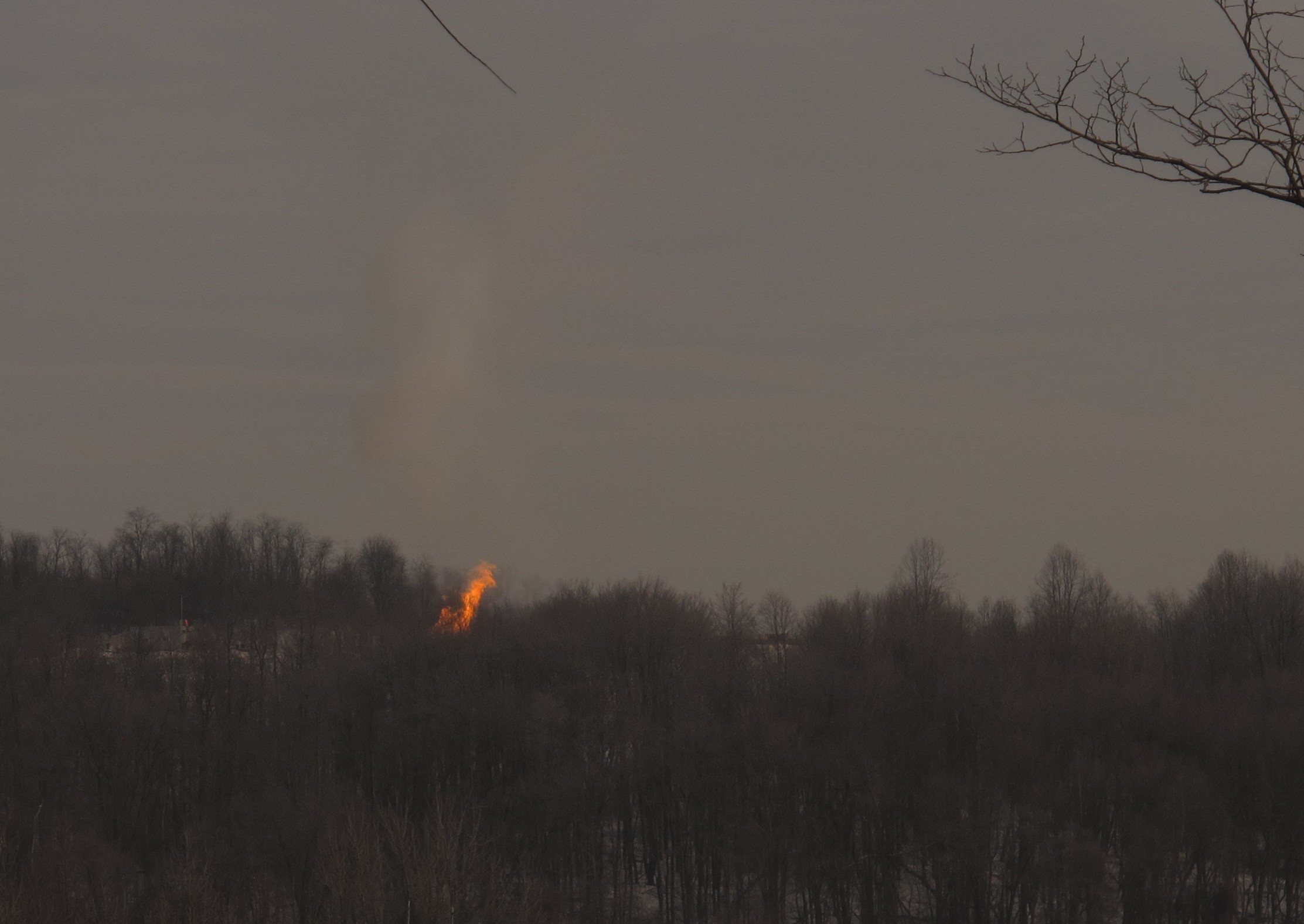
In a June 1st, 2015 article StateImpact reports on the gas well fire that sent flame so high into the air that the flames were visible for miles above the tree tops. Kati Coleneri reports, “Fires at two wells in Dunkard Township, Greene County burned for several days before they could be extinguished, but it took more than one week to find the remains of Ian McKee, 27, a contractor with Texas-based Cameron International who was killed in the blast.”
Katie Colaneri/ StateImpact Pennsylvania. A fire broke out on a Chevron natural gas well pad in Dunkard Township, Greene County, Pa. on Feb. 11, 2014.
Reports like this underscore the hazards of drilling anywhere near where people work or play. The $940,000 fine and the $5,000,000 settlement with McKee’s family dramatize the magnitude of the risks. Little wonder that insurance companies and mortgage lenders shy away from drilling sites. It also underscores how woefully inadequate the proposed ordinance being considered by the Jointure would be if enacted. It provides for unspecified insurance, and a maximum $50,000 financial security, described as laughable by critics.
As a former firefighter I confess I have no idea how to fight such a blaze. I don’t imagine that the first responders of our local communities do either. Well fires often require special teams to be flown in who are equipped with tools and techniques to snuff the flames and cut the flow.
I was shocked to see that PA State investigators were denied access to the site for two days and that there was no penalty assessed for doing so. What protections does state DEP oversight offer if a company with apparent violations can prevent the regulators from inspecting? It suggests that the gas industry has way too much influence in Harrisburgh.
FRACKING: A STORY OF UNINTENDED CONSEQUENCES & COLLATERAL DAMAGES
I don’t believe that the gas and oil industry intends to destroy our quality of life and our communities. This industry provides a good yield for our pension funds and portfolios—and makes a decent return for their investors. They provide fuel to keep us warm in the winter, fuel to power our electronic devices, fuel to drive our cars to the grocery store and our children to school, fuel to transport food from faraway places so we can enjoy strawberries in Dec. in Pennsylvania. They provide the fertilizers to grow our crops. They provide “mail box money” for landowners who allow them to drill on their properties. They provide jobs.
In fact our current oil and gas industry is a marvel of ingenuity. What was once a single oil well is now a shaft that can go miles vertically into the earth, with radial arms that turn and run horizontally for 2-4 miles. Who could have imagined such a thing even 10 years ago?
Another high performing profit sector is the chemical industry, which has created chemicals for all sorts of useful purposes. According to the EPA, there are more than 64,000 chemicals that have been created and are in use, chemicals that have not been tested for toxicity and that can be combined in countless new ways. Fracking wells can use a combination of up to 1,000 of these chemicals. All but 60 of these were essentially omitted from the EPA study released in June, 2015.
But what isn’t accounted for are the unintended consequences that are externalized to the surrounding community.
Property owners within a 1-5 mile radius may incur additional cost of insurance to cover losses in case of explosion on a site
Surface water contamination from fracking backflow can affect human health indirectly through consumption of contaminated crops, livestock or wildlife
Deafening noise and glaring lights around drilling rigs can make areas uninhabitable, increasing stress and disrupting sleep patterns
Noxious odors can impact air quality for miles around
Housing values drop and in some cases become worthless because banks will no longer provide a mortgage for their resale
Other industries are harmed like agriculture, tourism, organic farming, hunting, fishing, and outdoor recreation
Local enforcement officials and firefighters are overwhelmed with conditions they were never trained to deal with
Well shafts deteriorate over time and shaft leaks can occur in numerous places during drilling, releasing methane “a greenhouse gas 23 times more potent than CO2”
Health impacts can include low birth weight babies, birth defects, and especially the very young and the elderly experience allergies, skin rashes and lesions, asthma, bronchial conditions, and cancers
Each fracking operation requires several million gallons of water, of which only around a quarter is being recovered, depleting water sources, increasing tanker truck traffic on small, local roads, creating disposal problems
Exhaust from heavy truck traffic also contributes ultrafine particles (36 times finer than a grain of sand) laden with metals and hydrocarbons in hundreds of combinations, degrading our air quality and creating lung infections, chronic obstructive lung disease, strokes, ischemic heart disease, and lung cancer
Good paying jobs are created for a year or so and then the drillers and riggers move on to the next community and the next well, leaving only the permanent environmental and health costs for communities and citizens to deal with
Some people think that these impacts are just the price of doing business and enjoying the high quality of life we Americans prize, but people around the world are discovering that greater opportunity and innovation is available from “clean energy” industries like wind, solar, battery storage, and permanent, safe jobs like retrofitting homes and businesses and installing clean energy equipment. One small city in Southern France discovered they could generate more than $3 million/year with just a few wind turbines.
Most people believe that costs should be borne by the companies responsible for creating them, not left for the property owners or taxpayers to pay through their taxes or impacts on their health. As a nation, we are currently subsidizing the fossil fuel industries compared to renewable energy industries by a factor of 5:1. We, the people, have made a Faustian bargain. We can still make a new choice.
There is already national, bi-partisan legislation being considered that could allow a predictable, incremental transition from fossil fuels to clean energy sources over a 10-year period. This can be achieved by adding an increasing annual fee to every ton of CO2 at the source and returning all the revenues to American taxpayers on a monthly basis, much like the Home Energy Subsidy that Alaskans currently enjoy.
Wind, solar, and biomass already generate 2.5 – 9 times as many jobs as coal, oil and gas (for every $1 million contribution to GDP). Independent studies show that a Carbon Fee & Citizen Dividend would create more and better jobs (2.1 million new jobs after 10 years), increase GDP by $70-$85 Billion from 2020 on, and save 13,000 lives per year after 10 years due to decreased emissions and improved citizens’ health.
So we have a choice. Bucks County is temporarily protected from oil and gas drilling until 2018 under the Delaware River Basin moratorium. We don’t have to open a door, that once opened, we can’t close. Let’s remember the admonition that we are our brother’s keeper, and that allowing gas and oil drilling in a neighboring town will affect us as well.
Some of the advocates for Fracking seek to dismiss the concern about health risks as fear mongering. This document, assembled by health professionals, organizes and summarizes the facts available more than a year ago. There are even more now (see Links). However this compendium has been compiled to be accessible for decision makers and the public.
Systematically Organized Evidence of Fracking Risks. Source: http://concernedhealthny.org. (Click this image to download/read)
There is no question that fracking is dangerous and damaging to the environment. Someone said that “its hard to make someone see something when their paycheck depends on not seeing it.” We have too many who have been blinded by the prospect of “mailbox money” that comes from deep in the earth. Now we see that there is no free ride.
Fracking interests have long held sway over regulators and politicians in Harrisburg. So it was no surprise to see fracking advocates gloat when a federal EPA report seemed to support their contention that the objections to fracking were overblown. The editorial in the June 7th Bucks County Courier-Times echoed their fullsome sense of vindication:
“In a much anticipated study that was more than four years in the making, the EPA announced last week that it had found no signs of “widespread, systemic” drinking water pollution from hydraulic fracturing. As POLITICO reported: “That conclusion dramatically runs afoul of one of the great green crusades of the past half-decade, which has portrayed the oil- and gas-extraction technique as a creator of fouled drinking water wells and flame-shooting faucets.”
The editorial made it sound like some sort of trial had taken place, and that fracking was exhonorated of blame after due deliberation. In truth, the matter never came to trial. The report cited was actually inconclusive. “No evidence” was found because there was insufficient baseline data from before fracking to attribute the water quality problems to the onset of fracking activity. In other words there wasn’t a conclusive way to prove that the contamination came from fracking and not some other more mysterious source. Since the ingredients of the fracking fluid is “trade secret” the EPA investigators could not identify a proverbial smoking gun either.
The fact is that EPA cannot say with any certainty how widespread or systematic impacts to drinking water from fracking are, due to a lack of available data. (ecowatch.com)
Moreover, the data from Dimock where the famous flaming water taps were filmed, was excluded creating an obvious distortion of the statistics that favored the drilling industry. When you understand how politicians and the bureaucracies they oversee are influenced by corporations and trade associations, it’s easy to understand how an inconclusive study can be reinterpreted and molded to say what the administrators and pols want to hear.
“A thorough review of the study suggests that the EPA misrepresented the findings of its own study in both the press release and the high-level summary. EPA’s statement that it did not find evidence of widespread, systematic impacts fails to accurately reflect the uncertainty in the underlying data. The fact is that EPA cannot say with any certainty how widespread or systematic impacts to drinking water from fracking are, due to a lack of available data.”
We don’t usually expect political spin in supposedly objective scientific findings. And the EPA is catching plenty of flack as it gets scrutinized by those of us not satisfied with the “cooked” sound bites and summaries. The Courier editorial obviously failed to drill down for critical peer review before waxing poetic about the “not guilty” verdict. But then editorials are not necessarily informed opinion these days.
Journalistic kidding aside, the tone of the editorial suggests that nothing more need be considered:
“That argument now officially discredited, it is time to move on. Let us let the gas and oil industry do what it does without burdensome regulations and other unreasonable constraints that make mining economically impractical.”
There is a long and impressive list of peer reviewed scientific studies, not massaged or edited by politicians, that demonstrate serious health issues such as birth defects, low birth weight, and respiratory problems. New data shows elevated Radon levels in homes near fracking sites, and there is a lot more to come. The citations for some of these studies (easily found with Google) are on the “Links” page of this website [NoFrackingBucks.org].
There is certainly NO acquittal in sight for fracking, and the evidence foretells that the verdict will be “guilty as charged” if we can get an unbiased judge and jury.
Postscript:
On 6/23/15 an article in the New York Times reported that congress passed a bill that, “Would require EPA to start reviewing the toxicity of 64,000 unregulated chemicals, but at a pace of about 10 chemicals per year.” Sen. Lautenberg had wanted hundreds a year reviewed, but Chemical Industry Lobbyists got the bill’s language eviscerated – another illustration of corporate influence getting in the way of good science and the public interest. “The nation’s 10 largest chemical companies spent $171.4 million lobbying during the 2014 election cycle. Here we see an example of what they are buying.




You must be logged in to post a comment.