Category: Fracking Dangers

  • What Happened When Fracking Came to Town (Nonfiction)

    Issustration from Times book review.


    This is not news to followers of this blog, but we applaud the telling of the tale of misery and exploitation of ordinary Pennsylvanians. Click through and read the book review, buy the book, and send your comments to your PA legislators.  It is the politicians who have enabled this travesty. They need to know that we are fed up with the corruption, self-interest, and abuse.

  • Don’t Frack the Rich

    “This is why I don’t think they will come to central Bucks or even Wrightstown to frack. And this is why I suggested that we should put the zone for fracking in the jointure in land next to a McMansion development. That said, none of that would stop them from fracking in upper Bucks in the Delaware watershed and jeopardizing our aquifers and water supply. This couple’s story also elucidates why we need money from frackers for at least pre-fracking water testing. That’s gotta be in a fracking ordinance if there’s a way to include it.” —Robin Hoy

    With a contaminated well and no proof that drillers are responsible this couple buys their water by the truckload. [NPR]
    Read the State Impact article here (https://stateimpact.npr.org/pennsylvania/2016/06/06/dont-frack-the-rich-comment-puts-focus-on-environmental-justice/)

  • The Scary Physics of Deep Disposal Wells

    If you fill a vertical pipe with water, the weight of the water produces pressure at the bottom of the pipe. That’s why we have water towers. A typical water tower is about 100 feet tall and produces about 40 to 50 pounds of pressure at ground level.

    Imagine if you could build a water tower 10,000 feet (2 miles) high. The pressure would be 4,000 to 5,000 pounds.  A deep well is like a tall water tower. The pressure at the bottom is equal to about half a pound a foot for each foot. That is the kind of pressure it takes to fracture rock layers. Deep disposal wells create that sort of pressure in the rock without the help of pumps because of the sheer weight of the water poured in at the top. Unlike the fracking process which last hours or days, the disposal well pressure is unrelenting. Over months and years and decades and centuries it is still there. The consequences are unpredictable. But Oklahomans have a pretty good idea what some of them are.

    12,000 lb bottle jack


    Think about a hydraulic jack.  A small piston or pump produces a high pressure per square inch. My travel trailer weighs 12,000 lbs.  Yet I can lift it with a little bottle jack. (Click the picture to learn how it works.)

    The deep well shaft is analogous to the pump part of the jack. The miles of subterranean porous rock surrounding that well are like the lifting piston. The drilling company would like us to believe that nothing will happen when they add tons of polluted frack waste water to the well. Good luck with that. Their little company, all its owners, and all its employees may be long dead, but that well will still be there trying to lift the miles of earth around it.


  • Worse Than Fracking? [Yes]

    Wastewater disposal wells are bad news. Such wells have caused earthquakes in Oklahoma and Texas, and now they may come to Pennsylvania. What’s even more alarming and disgusting? Our taxes are being used to make it happen! The State of Pennsylvania has issued permits for the wells and simultaneously filed lawsuits to overturn the local government’s attempt to block them. (Read Article)

    Philadelphia Inquirer

    If that doesn’t make your blood boil, also consider the fact that there is little benefit and much harm to Pennsylvanians. Sure, if you own stock in a gas energy company, or have one of the few jobs they create, you might have some near-term benefit.  But the gas is not for domestic needs — there is already a glut. It’s for overseas markets.  The governor does hope to attract plastics makers who can use natural gas as a hydrocarbon source. But that is not the motivation for any of this. The hidden agenda is to sell the gas as fast as possible before its use is banned to save the planet.

    Global climate change is a major economic disruptor that looms ahead of us. Models differ on how soon each of its principal life-threatening effects will be impossible to ignore.  The process seems to be accelerating. As we have been saying for years, nothing good comes of fracking.

    Related News: http://www.pennlive.com/news/2017/03/thats_not_deps_role_outrage_an.html

    [Thanks to Charlie Peterson for the tip.]
  • 52 Homes Without Water Six Years

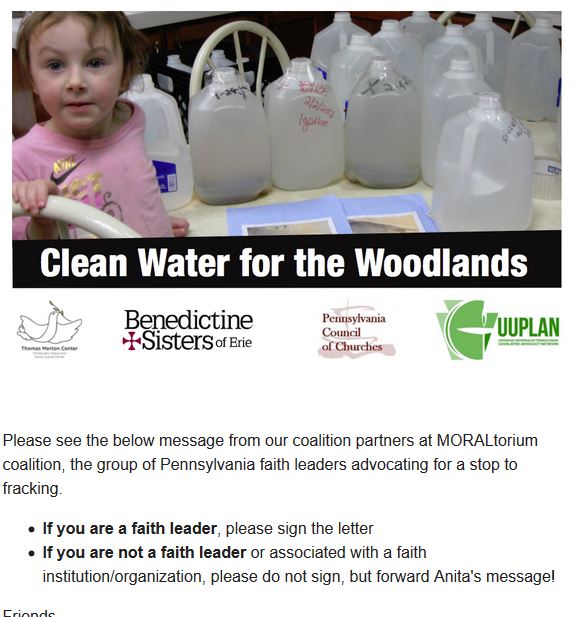
    Activist groups and especially faith leaders are helping the families in Woodlands, PA whose water was fouled by fracking. You may want to read and respond to their appeal. But my purpose in posting it here is to bring home that shale gas extraction has bad consequences.  Has anything really changed in the regulatory framework that allowed this travesty six years ago? Why aren’t those responsible making it right?

    There will probably never be satisfactory answers.  Laws and regulations fall far short of strict accountability and compensation for environmental damage. And the industry successfully lobbies to keep the enforcement understaffed and encumbered. This is why we must prevent unsafe shale gas extraction here in Bucks County – nothing good comes to locals.

    Read more …
  • EPA: Contamination at every phase of the fracking process.

    Reposted from Pennsylvanians Against Fracking


    FOR IMMEDIATE RELEASE
    December 13, 2016
    Contact: Danielle Filson, danielle.filson@berlinrosen.com, 646-335-0443

    BREAKING: EPA Listens To Science Advisory Board & Confirms Fracking Impacts Drinking Water

    Alters Controversial Earlier Finding, Acknowledges Science & Research

    The EPA today finalized its report on fracking’s impacts to drinking water resources following the EPA Science Advisory Board’s (SAB) review of the EPA’s June 2015 draft study, reversing itself to confirm that fracking has an adverse impact on drinking water. For over a year, a panel of 30 scientists, engineers and industry consultants have reviewed the details of the 1000-page draft report. The panel took particular issue with a finding that seemingly came out of left field: the agency’s statement that fracking has not led to “widespread systemic impacts” in the United States, which did not have clear, scientific basis of support.

    After thoroughly reviewing the demands from the EPA Science Advisory Board, comprised of the EPA’s own scientists, the agency released the final report today, heeding their recommendations and clarifying that the agency found contamination at every phase of the fracking process.

    The EPA and independent peer-reviewed studies have identified many mechanisms of contamination, such as spills, well cementing failures below ground, and complications with waste disposal. The EPA originally found there was on order of 15 spills every day somewhere in the United States, yet chose to dismiss those daily incidents.

    This decision follows concerted outreach from affected individuals, public interest groups, and the EPA SAB, who submitted comments in taking issue with how the agency ignored three high-profile contamination cases in its study – notably Dimock, Pennsylvania; Parker County, Texas; and Pavillion, Wyoming. The agency’s omissions were contentious in part because in each case, the EPA prematurely abandoned investigations. The EPA SAB recommended that the agency include detailed summaries of these critical cases, which have now been added.

    “The EPA made the correct decision in acting on the recommendations from the EPA SAB and confirming what we have seen firsthand, that fracking for oil and gas damages water supplies in Pennsylvania and across the country,” said Karen Feridun of Pennsylvanians Against Fracking. “In Pennsylvania, there have been more than 283 documented cases in which fracking damaged private drinking water supplies and countless others that have yet to be determined by the Department of Environmental Protection, like the dozens of cases in the Woodlands. We also know that fracking operations in Dimock contaminated local water supplies. Pennsylvania has been infiltrated with fracking, and many of the public health reports coming out use Pennsylvanians as subjects. It is now more important than ever that Governor Wolf heed the requests of the Pennsylvania Medical Society and implement a statewide fracking moratorium.”

    This is a clear sign from the EPA that it is choosing to prioritize the health and safety of the American people over the political interests of the oil and gas industry. With the pick of Scott Pruitt to lead the Environmental Protection Agency, the incoming administration has made it clear that it is willing to sacrifice public health and deny the existence of climate change. We are grateful that the agency has chosen to side with science, research and logic and hope that this is a first step toward a nationwide ban on fracking.”

    More than 179,000 signed a petition to EPA Administrator McCarthy, calling on the EPA to retract the draft report’s conclusion and commission an independent, peer-reviewed study on fracking’s impacts on drinking water that is free from industry bias. A March 2016 Gallup poll found that Americans oppose fracking 51-36%, and an October 2016 Yale study that links chemicals that cause cancers, including childhood leukemia, to fracking. The fourth edition of The Compendium of Scientific, Medical, and Media Findings Demonstrating Risks and Harms of Fracking was recently released in November 2016, bringing together over 900 peer-reviewed findings and studies from the scientific and medical literature, government and industry reporters, and journalistic investigation. It demonstrates a now pervasive body of scientific evidence of risks and harms, health impacts and air, water, and soil contamination, along with climate impacts of fracking.

    About Pennsylvanians Against Fracking

    Pennsylvanians Against Fracking is a statewide coalition of organizations, institutions, and businesses calling for a halt to fracking in the Commonwealth. Steering Committee member organizations include Berks Gas Truth, Delaware Riverkeeper Network, Food & Water Watch, Marcellus Outreach Butler, Marcellus Protest, Pennsylvania Alliance for Clean Water and Air, and Thomas Merton Center. Learn more about Pennsylvanians Against Fracking atpaagainstfracking.org.

    ###

    (more…)

  • DRBC Moratorium Challenged

    In litigation aimed at challenging the moratorium on shale gas extraction (fracking) in the Delaware Valley, three PA senators are asking the court to declare that the Delaware River Basin Authority does not have the authority to regulate drilling in the basin. According to Environment and Energy Daily reporter Ellen Gilmer, In a court filing this week, state Sens. Joseph Scarnati, Lisa Baker and Gene Yaw urged the U.S. District Court for the Middle District of Pennsylvania to allow them to join a group of landowners challenging a long-standing drilling freeze in the 13,539-square-mile watershed, which includes parts of Pennsylvania, New Jersey, New York and Delaware.

    A portion of the Marcellus formation lies under the river basin in north-eastern PA and north-western NJ, and the hope of big profits from the gas trapped there has seduced people to want the ban lifted despite the dangers to water, air, and the health of residents near extraction sites.

    Bucks County is over the Newark Basin Shale, not the Marcellus. There are no producing wells in this formation and two exploratory wells drilled years ago have since been plugged with no conclusive evidence that further exploration would find economically attractive extraction possibilities.  Of course even if the exploration companies were optimistic, we wouldn’t expect them to be forthcoming with their knowledge.  But, a 2007 technical article concluded:

    The results of drilling the two wells in the Newark basin of Pennsylvania provided an initial insight into subsurface conditions.

    It allows a broad correlation of seismic data with subsurface conditions. It also exposed the fact that the subsurface characteristics of this basin are more complex than the “cookie cutter” geology that has been imposed upon it since the mid-1800s.

    Reservoir analysis suggests that there is a thick, organically rich, siltstone-shale-mudstone complex in basin center that is apparently equal to other great fractured shale reservoirs.

    With a thickness ranging from 2,500 ft to over 4,000 ft, the Lockatong member could host many significant local reservoirs that could produce economic amounts of relatively dry natural gas. In addition, there is a possibility that sandstones with porosity might lie in proximity to the organic shale, and could, under the proper conditions, be significantly large natural gas reservoirs.

    Finally, the author believes his original model for the basin is still viable. If this is the case, then fluvial sand buildups in proximity to the organic shale could be present and could form significant sand reservoirs.

    There is too little subsurface information available to the geological community to allow a more precise discussion of reservoir development or location at this time. What can be stated is that there is a good possibility that a significant reservoir in an economically attractive location may be present.

    The author will conclude with the comments of two geologists who do not wish to be identified. One geologist said, “This reservoir looks better than the Barnett, even at this early stage of development.” The other said, “Given the limitations of the dataset and the variables of basin configuration, what we may be looking at is one of the last significant, completely undeveloped reservoirs left in the world.”

    The lacustrine reservoirs of the Newark basin hold great potential and should encourage further testing by drilling. [source: Art Pyron www.ogj.com]

    I can’t help feeling that it’s only a matter of time before there is renewed interest in exploring the Newark Shale. It’s closer to the surface (3,000 feet instead of 5 to 7,000) and it will be close to the Liquefied Natural Gas (LNG) hub proposed for Philadelphia. So when people tell you there is no gas here, beware. In the industry it is said there is “no known gas” until it’s proven with a producing well.

  • Revised Proposed Drilling Ordinance (Jointure)

    Here is the latest iteration of the zoning ordinance proposed by Solicitor Clemens as what he views as the best the Jointure can do to exercise control over future attempts to site fracking drill pads in the three municipalities. The legal strategy is to avoid including provisions that the State of Pennsylvania will not allow the municipality to enforce, but to include provisions that a municipality has the right to enforce.

    I am not a lawyer, but my early training as a contract administrator made me aware of the kinds of language that leaves wiggle room and sets the stage for litigation. This proposed ordinance has a lot of subjective criteria that would be difficult to enforce and is silent on most of the risks to health and the environment that fracking creates. See for yourself …

    (Click to see ordinance as red-lined by the Solicitor.)

  • Evidence of Health Impacts Grows

    Nicholas Bakalar writing in the NY Times reports that “Living Near a Fracking Site is Tied to Migraines, Fatigue.” While this is no surprise given the growing body of scientific evidence, this data is different because it was gathered from randomly selected members of a large Pennsylvania health system who were sent a health questionnaire. So the researchers didn’t rely on patients who came forward with complaints, but surveyed a cross section of people and identified those who were diagnosed with sinusitis, migraine, and fatigue. When the data was cross tabulated with closeness to fracking sites and larger wells, the link was evident.

  • Science Supports Health and Environmental Fears

    Screen Shot from PSEHE Site
    Just the facts – Check this out.

    Dr. Anthony Ingraffea and his colleagues at Physicians Scientists and Engineers for Healthy Energy have been working for years to create an archive of the science that reports on fracking. It’s no surprise that the preponderance of evidence shows unacceptable harm to people and the environment. This is not hype or rhetoric. It stands in sharp contrast to the slick whitewash of the energy industry PR copy.

    PSE Healthy Energy has studied this literature and provides you with an overview that’s understandable in layperson’s terms. Browse the site – it’s eye-opening and rigorously accurate.