I’m an old man. At 84, I don’t expect to live to see the consequences of the denial that energy industry propaganda has caused. My kids will, and my grandkids will.
Climate change is accelerating exponentially. A number of destructive vicious cycles are on the verge of being triggered. Once they are, our once-stable ecosystems will become even more chaotic than they are now. Humanity will not be capable of reversing the cascading catastrophic changes.
Buried in the body of one of the Lithium stories are these cautionary words:
Even if the process of extracting lithium proved to be cost-effective, Quigley said, it should not be used as a justification to keep drilling, though it was “inevitable” that the industry would try to use the finding that way. “It’s still not a reason to continue to drill, because it’s a waste product from fossil fuel extraction,” he said. “The economy has to be carbon free by 2050.”
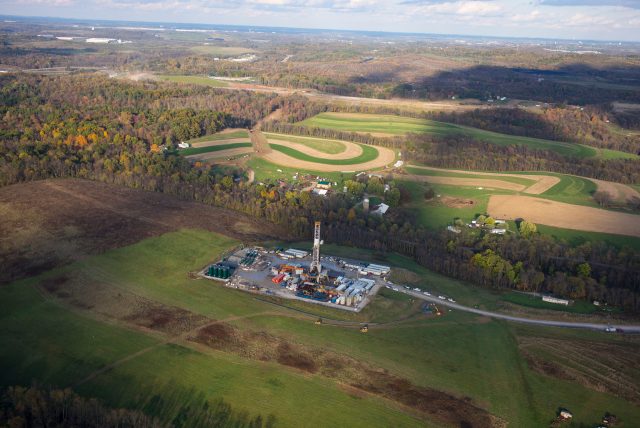
Extracting lithium doesn’t solve the ongoing problem of what to do with the highly toxic wastewater produced by fracking, which contains salts, metals and radioactive elements. “There’s no way to clean this stuff up,” Quigley said. “You might be able to get something beneficial out of it. But you still have really nasty wastewater that you’ve got to get rid of.”
Quigley was reminded of previous claims made about the economic usefulness of the oil and gas industry’s wastewater in Pennsylvania. Spreading wastewater from conventional drilling on roadways to suppress dust was once considered “a beneficial reuse,” but now faces scrutiny for the risks it poses to the environment and human health, including water contamination and harm to aquatic wildlife. “That has proven to be a sham,” Quigley said. “Some beneficial reuses turned out not to be so beneficial.”
“You might be able to get something beneficial out of it. But you still have really nasty wastewater that you’ve got to get rid of.”
— John Quigley, a fellow at the Kleinman Center for Energy Policy and a former secretary of the Pennsylvania DEP and the state’s Department of Conservation and Natural Resources, as quoted in the article below.
Fracking wastewater has “shocking” amount of clean-energy mineral lithium
40% of US need for lithium could be covered by Pennsylvania’s fracking byproduct.
Justin Nobel asserts that radiation levels at some oil and gas facilities within small American towns are higher than those at the exclusion zone around the site of the 1986 Chernobyl nuclear disaster.
How Fracking Is Making Some U.S. Communities More Radioactive Than Chernobyl
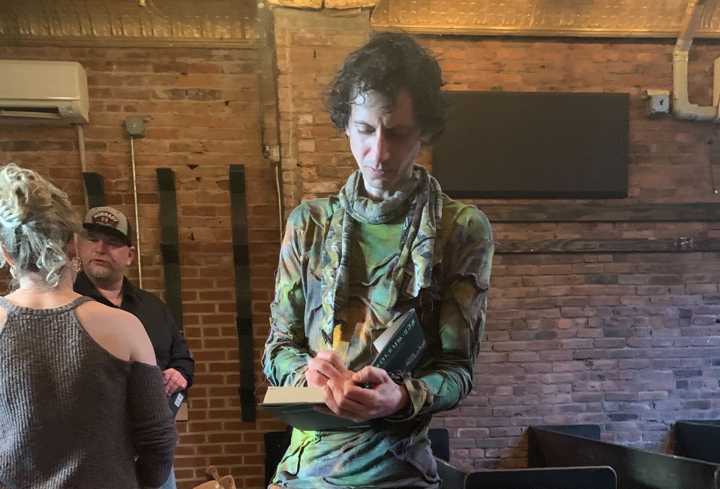
A Q&A with DeSmog reporter Justin Nobel about his revelatory new book, Petroleum-238, that takes on the fracking industry for exposing workers to radioactive contamination.
It’s not news to us, but the evidence continues to build that nothing good comes of allowing fracking. Here’s a report from our Bucks County Courier Times, that adds to the irrefutable evidence.
Study shows links between Pa. fracking, health of kids
More asthma, cancer cases found near plantsMarc LevyASSOCIATED PRESS H
The industry continues to assert that fracking can be done safely. Still, the evidence shows that profit-driven businesses are not up to the task and often lobby to prevent authorities from holding them accountable. I should not need to remind readers that taxpayers are paying to close hundreds of thousands of abandoned wells. If fracking can be done safely, then every case of leaks, venting, water degradation, and well abandonment is a case of negligence–is it not? I don’t see the industry stepping up to take responsibility for the damage it has done through past negligence. Nor are they lobbying for rigorous enforcement to keep marginal operators in line and to fund the mitigation of damage done.
“A new peer-reviewed study from PSE suggests that prioritizing plugging wells closest to people may bring extra health benefits. Gas leaking from wells is known to be mostly methane, a potent climate pollutant. Scientists tested gas from 48 abandoned wells in western Pennsylvania and found that gas leaking from wells can contain benzene and other volatile organic compounds, suggesting that leaked gas from abandoned wells is also a health hazard.” ~ PSE Newsletter
Chemical Makeup of Gas Leaked from Abandoned Wells | PSE | Physicians, Scientists, and Engineers for Healthy Energy
Corporations are not people, contrary to popular belief. They are legal constructs designed to bundle up real and intangible property and the responsibilities that go with ownership of the bundle. This allows you and me to own a share of General Motors and not be responsible for its debts and liabilities if the enterprise fails.
But what happens if someone games the system? The limitations on liability and the opportunity to escape from responsibility provide an opportunity that has value. Let’s say you own a fleet of taxi cabs. Insurance is expensive, and your drivers, good as they are, can’t avoid accidents with personal injury claims. So you incorporate each of your cabs, buy the minimum insurance that’s allowed, and if there’s an accident? Well, that cab is the only thing of value in the corporation after the insurance pays its limit. The corporate veil protects you as the shareowner.
Now suppose a bunch of wealthy oil barons are worried about future liabilities of their depleted oil wells. Read this.
Wells
Diversified Energy Co. buys up oil wells that other companies no longer want any part of, holding 61,100 wells as of the end of 2020, the most in the country and considerably more than oil majors like Exxon Mobil (36,900 wells) and Chevron (25,800 wells). The rate at which the company is buying up wells is worrying regulators and industry groups because states require a company to plug a well with cement after it runs dry, and some think the rate that Diversified is paying out dividends and buying up wells means that it won’t have the funds to hold up its side of the bargain once bills come. That could leave states like Ohio, Pennsylvania and West Virginia on the hook to clean up a mess that could cost billions. Many wells have methane leaks, a ton of which causes 80 times the warming over the next 20 years that a ton of carbon dioxide would.
Citing unfavorable business climate and COVID-19 Elcon has withdrawn its application for a toxic wastewater facility on the banks of the Delaware. Many of us voiced out protests repeatedly at hearings and public meetings. The siting of the facility was seriously flawed and the the application had many serious deficiencies.
We should remember that the permitting process exists to allow things to be done that are generally not allowed. Often private interests seek permits that are clearly not in public interest, and which, if granted, would degrade the quality of life and impose risks to the environment. We celebrate the decision to withdraw, it was an ill conceived project from its inception.
Elcon withdraws application for large hazardous wastewater plant in Bucks County
Elcon Recycling Services will withdraw an application to build a large facility in Fairless Hills that would have processed up to 210,000 tons of liquid chemical waste annually for recycling.
My family has deep roots in the original Chautauqua — my wife calls it summer camp for grownups. For many decades people have pilgrimaged to this small community for intellectual, spiritual, and physical renewal. Alas, COVID-19 forced cancellation of the program on Chautauqua Lake near Jamestown, New York.
But be of good cheer, it’s free and you can participate from home starting Monday.
Don’t miss the Chautauqua Lecture Series …Climate Change: Prioritizing Our Global and Local ResponseHow we talk about climate change is rapidly shifting. But amid the ongoing political debates, how are we — and should we be — responding? All events are at 10:45 a.m. unless noted.Monday, June 29: Christine Todd Whitman, former administrator of the Environmental Protection Agency, on “Government, Economics and Climate”Tuesday, June 30: Janis Searles Jones of Ocean Conservancy on “The Ocean and the Climate: How to Save Both”Wednesday, July 1: Katharine Wilkinson of Project Drawdown on “How to Reduce Greenhouse Gases”Thursday, July 2: Former UN official Amb. Christiana Figueres on “The State of Global Environmental Action”Please note a special start time of 11:30 a.m. for this programFriday, July 3: Geoffrey Kemp and Amb. Barbara K. Bodine discussing “The Geopolitics of Climate Change and the Environment”
Government, Economics and the Climate – Climate Change: Prioritizing our Global and Local Response – CHQ Assembly
Christine Todd Whitman opens the week highlighting the role of government in combating climate change, what climate action looks like in economic terms and how Americans across the political spectrum can come together around collective action. Whitman, the first female governor of New Jersey, a…
Conversation over lunch or coffee is a big part of the Chautauqua Experience. At Pennswood, the community where I live, we are organizing Zoom/Conference Call discussion groups for those interested. If you want to participate in one of these, please use the contact form to let me know.