ODNR links earthquakes to fracking operations in Noble County – Farm and Dairy
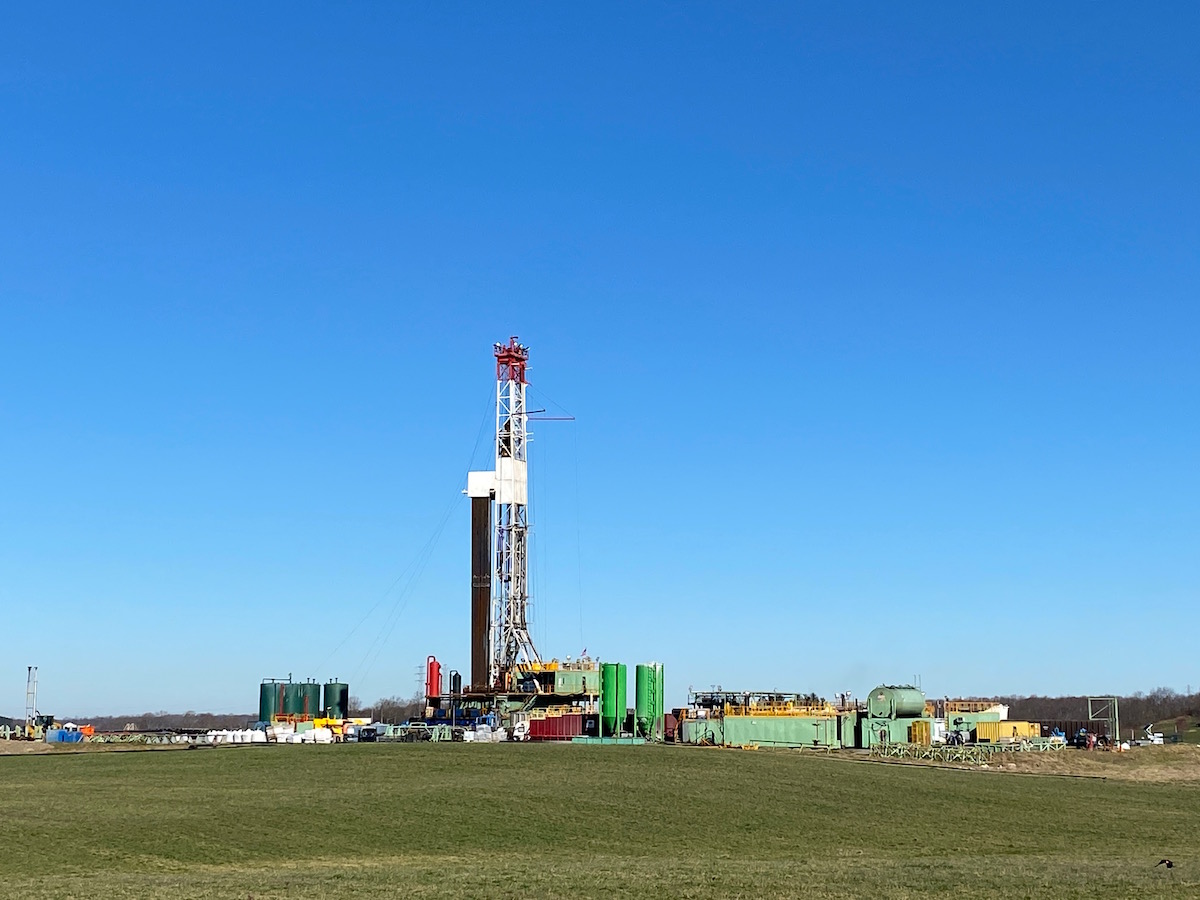
Several earthquakes in Noble County, Ohio were linked to hydraulic fracturing operations at a well pad; the Ohio Department of Natural Resources halted operations.
Ohio fracking operation suspended in connection to recent earthquakes
An ODNR official said some of the quakes were strong enough to be felt.
It’s called a “permit” because our society is accepting as necessary, something that is not otherwise desirable.
Pa. Senate bill would cut impact fees for communities that restrict fracking
Former DEP secretary David Hess says a Senate bill is meant to punish communities that try to protect their health and environment from fracking impacts.
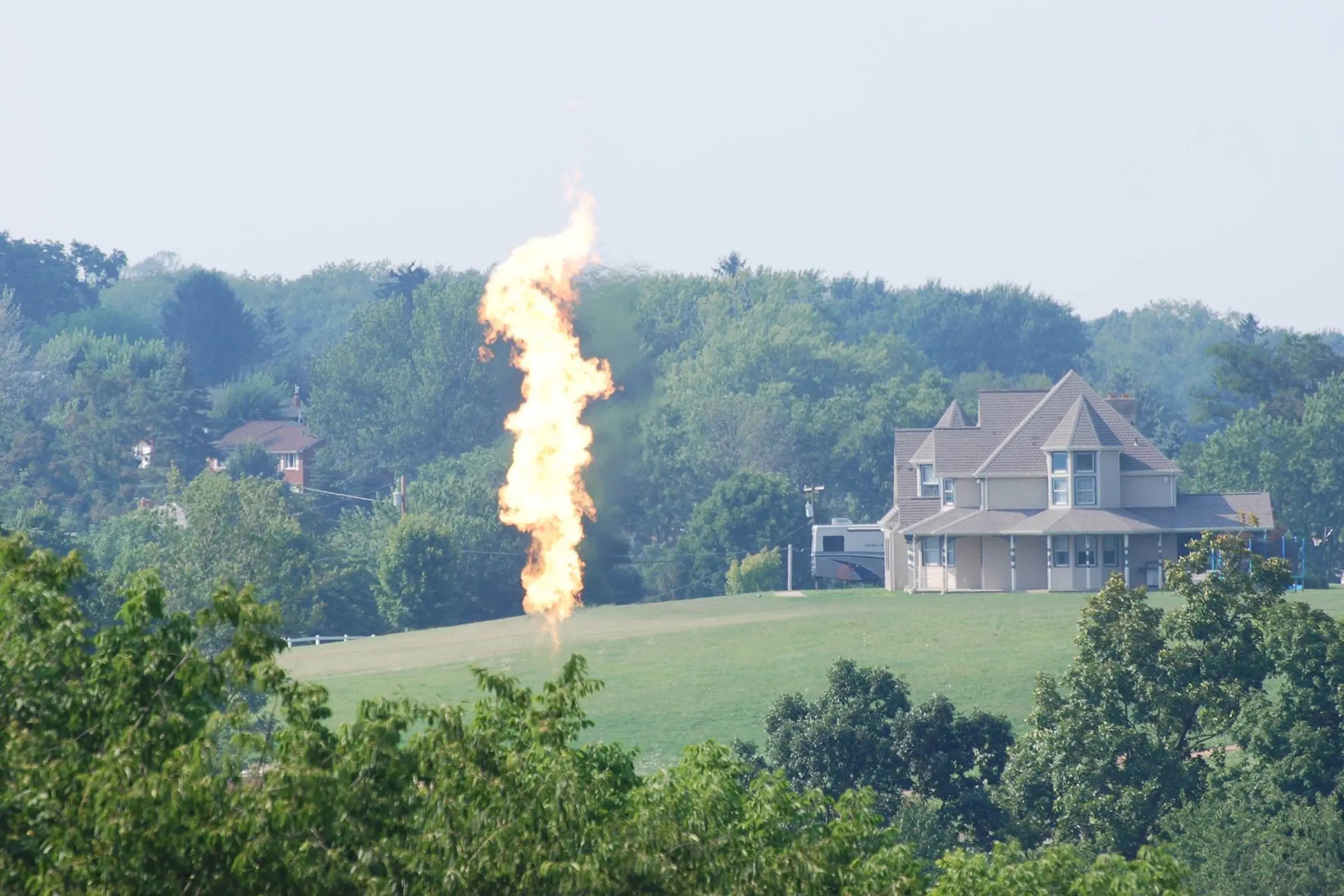
Contrary to industry cheerleading, gas is not a better energy option than other fossil fuels. Fracking destroys agricultural and forest land, pollutes air and water and poses serious risks to public health, e.g., seven times the risk of lymphoma and a 20% increase in hospitalizations for children with asthma.
Increasingly, Pennsylvania residents don’t want these industrial operations near their homes, schools or churches. The letter “We need truth on air quality” (May 6, TribLive) challenged area air monitoring results that indicated poor air quality because, the writer noted, some monitors were placed near frack operations. However, approximately 1.5 million Pennsylvania residents live within a half-mile of oil/gas wells, and millions more near compressor stations and processing facilities. A perhaps unintended message was that Pennsylvania residents get it, fracking is a dirty business.
The letter “Data center concerns, opportunities” (May 2, TribLive) supported the proposed Upper Burrell AI site because it will provide its own energy. However, “its own energy” will come from six on-site fracked well pads. All of this is a real concern as research continues to indicate serious health concerns, as violations mount (roughly 25,000 since 2008), and unplugged frack wells are abandoned (171 to date) with plugging expected to cost up to $8.5 billion.
The Trib has reported on local action on zoning ordinance restrictions for solar and wind sites. Is the same consideration being given to frack sites which pose real risks to the land and residents? If not, why not?
Texas Oil and Gas Companies Drill With River Water During Extreme Drought – Inside Climate News
Oil and gas companies have used billions of gallons of Rio Grande and Pecos River water for drilling in the past four years, according to an exclusive Inside Climate News analysis.
Billions of gallons were contaminated during the “extreme drought,” and for what? Cheap fuel. Only it’s not cheap. The price at the pump doesn’t include anything for the harm done in making that fuel or by burning it.
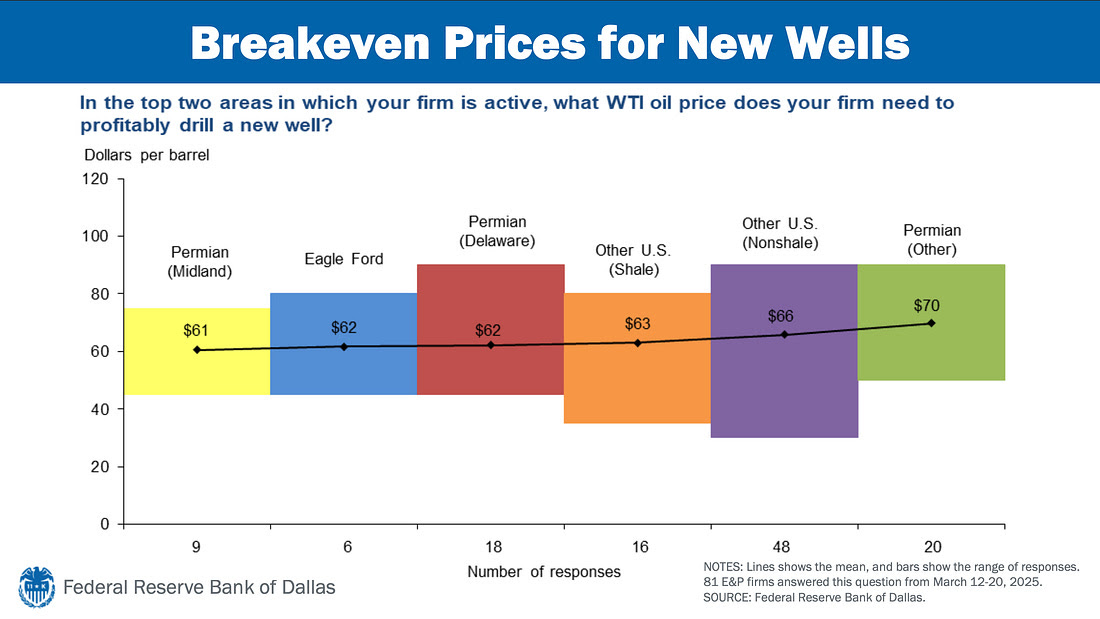
Paul Krugman’s 5-13-25 column provides a key insight into the relationship between renewable energy and fossil energy. Renewables are competitive, even when we don’t take into account the hidden subsidies society provides fossil fuels by tolerating the externalized environmental damage. If a driller can’t get at least $60 a barrel for oil produced, it doesn’t pay to drill. Gas has a similar threshold of profitability. So when the energy industry waxes poetic about the benefits of drilling, look for the dodge and the gimme. The driller needs a premium price for the energy he mines. And the cost of renewables will continue to drop.
In the case of shale, it’s all about prices. Drilling new shale wells is expensive. In fact, Trump’s vision of drastically lower oil prices never made any sense, because any large drop in oil prices would make new shale wells unprofitable. And since production from any given shale well drops quickly over time, anything that caused new drilling to fall substantially would quickly translate into declining oil production.
How low would prices have to go to shrink the U.S. oil industry? Recently the Dallas Fed did a survey which suggested that drilling in many major fields would stop if the price per barrel fell below the low 60s:
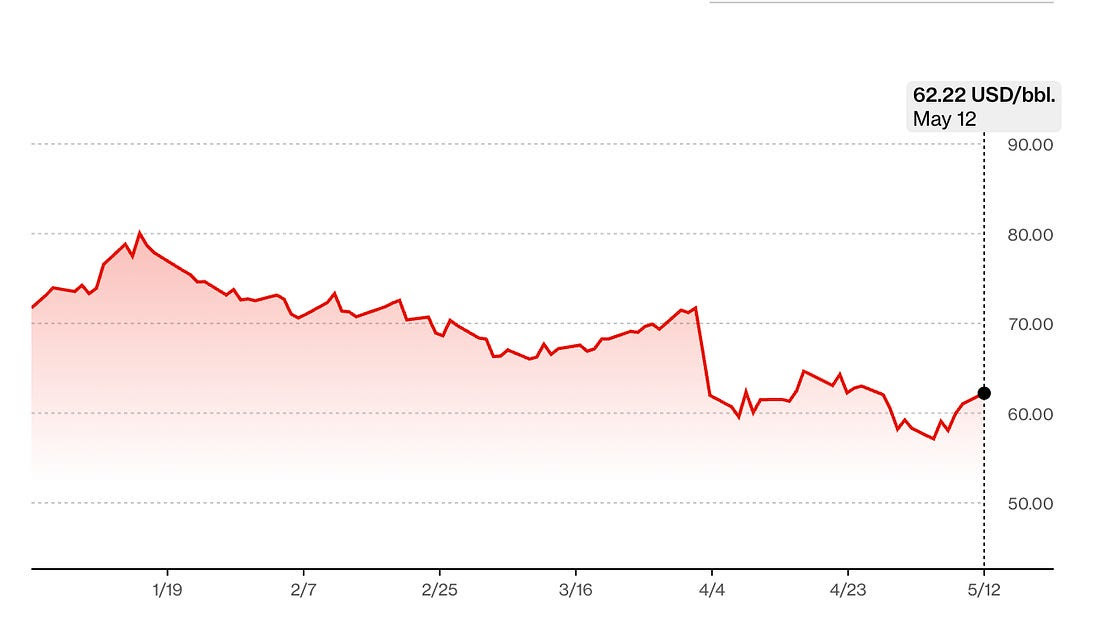
And that was before Trump’s tariffs raised costs, so the critical price is probably higher now. And guess what: oil prices right now are at a level where we can expect production to fall. Here are oil futures:
Source: Bloomberg
Why did oil get cheap? Look at the sudden drop on April 2, aka Liberation Day, when Trump first announced extreme tariffs. It’s obvious that oil prices are down thanks to pessimism about the global economy, which in turn is tied to Trump’s trade war. And by the way, that war is by no means over. A new analysis by the Yale Budget Lab finds that the damaging effects of Trump’s tariffs are only modestly mitigated by his surrender to China.
And as for renewables: Trump hates them, wind power in particular. He offers crazy justifications for that hatred — did you hear about his claim that offshore wind farms kill whales? — but it’s pretty clear that he has been nursing an irrational grudge ever since he was unable to stop a Scottish wind farm that he thought ruined the view from a golf course he owns.
Oh, and I’m pretty sure that MAGA types in general dislike renewable energy because they don’t consider it manly.
So what will be the economy-boosting effects of drill, baby, drill? Nil, baby, nil.
No regard for the obstacles deservedly placed in the path of businesses that exploit natural resources. It is all about commerce and profits. The greater public good is a distant priority.
GOP Advances Bill to Fast-Track Fracking, Logging and Mining on Public Lands
The legislation would make it harder to file legal challenges against controversial mines and pipelines.
Footnote: The source of the above article is Truthout, an extremely left-biased source. Although they don’t usually publish lies, they do omit context and considerations that tend to favor the right.
Wright’s critics see his views on global warming as a dangerous and self-serving misinterpretation of climate science. In their view, the fundamental role of fossil fuels in modern life is precisely the problem. Without a rapid shift to other energy sources, humanity risks undoing the types of progress Wright and his allies love to celebrate.
Don’t call it ‘climate denial,’ Secretary of Energy Chris Wright claims he’s preaching ‘climate realism’
As a Denver-based fracking executive, U.S. Secretary of Energy Chris Wright honed a message on global warming: yes, it’s real, but it’s a manageable side effect of modern life.
More and cheaper fossil fuel is the wrong direction to take. The damage caused by the use of fossil fuels and products made from them is conveniently externalized. Gas and oil are cheap because the user does not pay for the life-cycle cost, only for the initial production and distribution costs. And, in many hidden ways, the production cost is subsidized. Though he doesn’t mean it this way, true “climate realism” would assess the full life cycle cost of the fuel and include that as a penalty tax. But how do you price loss of coastline, extinction of species, wildfires, floods, and extreme weather? What’s the value of the casualties, what could compensate the child with asthma?
We aren’t even sure that humanity will survive what’s coming.
The article below is presented as an example of propaganda produced to promote fossil fuel interests. The charged language, attacks on people instead of issues, lack of evidence all should be a tip-off. And your skepticism is confirmed by Media Bias Fact Check, and organization that holds sources accountable by checking facts and tracking the integrity with which they report. Here’s what they say about Townhall the source of the article:
Overall, we rate Townhall Right Biased and Questionable based on consistent one-sided reporting that always favors the right and numerous failed fact checks.
Senator Dave McCormick wrote an op-ed for the Washington Times that says, “The more I travel across the Commonwealth, the more convinced I become of the potential Pennsylvania has to guide America’s energy future. Philadelphia Gas Works is working to export LNG through the Port of Philadelphia. Penn America Energy and the Pennsylvania Building Trades are collaborating on a $7 billion project to build a new LNG export terminal along the Delaware River in Eddystone.”
It’s a bad idea for many reasons, both economic, global, and local. The reason energy interests want the terminal is to exploit foreign markets. Natural gas can be burned or made into plastics and chemicals. If burned, it contributes to global climate change. Plastics are polluting everything because we don’t have practical ways of recycling them. So whatever happens to the gas we liquify and sell, those who profit don’t pay the long-term costs; society does.
The social economics are bad too. Cheap fossil fuels compete with renewable, non-polluting energy. So their availability hinders the growth of sustainable energy production.
Then there are the pipelines. They create long, deep scars across the landscape and introduce the risk of leaks and disasters to the neighborhoods they traverse. The pumping stations vent substantial amounts of gas, and create other damage to the neighborhoods where they are located.
Last but not least is fracking. Overseas markets increase demand and bring higher prices, which encourages more drilling. We’ve extensively documented that nothing good comes to locals from fracking.
Senator McCormick is only telling half the story, the rosy half. He’s left it to the rest of us to tell the whole story and reveal the truth. You get all the facts right and still mislead people.