Blog

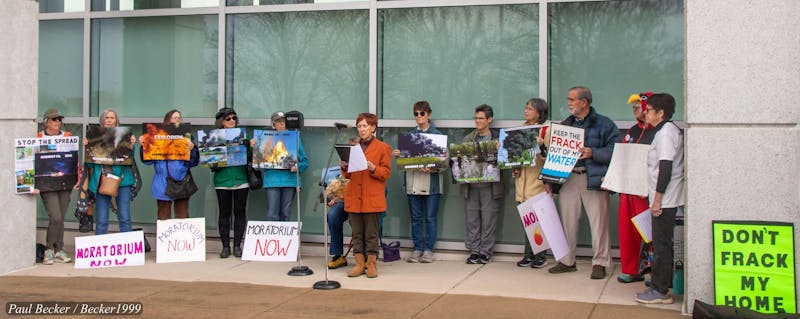
  • Locals Protest to Protect Water

    “Because the majority of Ohioans rely on groundwater for their drinking water, the threat of fracking byproducts, like radioactive brine, seeping into their drinking water supplies is not a small one. For example, in Athens County, fracking-produced brine has been found migrating over a mile away from its source since 2019 — inching its way toward groundwater drinking wells. The migratory activity of fracking byproducts makes fracking a statewide concern, including in Southwest Ohio.

    “If just one aquifer is poisoned in Ohio from migrating radioactive gas and oil waste brine, it could affect the drinking water for tens of thousands people who rely on well water for drinking,” Zemper said.

    Read more. Click the box below.

  • Shapiro Criticized

  • Who Will Protect the Public Interest?

    Fracking does nothing to improve the landscape, the roads, the air, the water, or the lives of the locals. And energy companies are devious and without honor in these matters. Who will safeguard the parks?

  • Can’t Make it Go Away

    When you throw something away, where is “away?” The Westmoreland County Landfill is one “away” place where fracking waste is disposed of. But there is no away. The fluids leach out of the landfill and must be disposed of, or should we say disposed of again. WSL currently transports radioactive leachate and other chemically-laced liquid waste to treatment plants, but is seeking a new National Pollutant Discharge Elimination System (NPDES) permit to discharge liquid waste directly into the Monongahela River, via a pipeline. What could be wrong with that idea?

  • Climat News

  • The Waste Doesn’t Just Go “Away”

    Fracking does nothing good for the environment.

  • Information and Propaganda

    If you read the following article, you would think that fracking was a benign technical option. The problem with articles like this one should be obvious. It fails to address the history of things that can and do go wrong. Nor does it discuss the issue of sealing abandoned wells, which may be a practical impossibility once we punch holes through layers of rock. Steel rusts, concrete cracks, but the hole they attempt to seal with those materials is there forever. There is a long history with plenty of evidence that wells leak, and companies drill negligently, or exhaust their financial resources and fail to do as they should. The locals bear the long-term risks and costs. The lie is in what’s not said.

  • Guess Who Pays the Bill?

    Players in the energy industry know how to skip on their cleanup obligations. Nobody wants to admit to it, but there are ways to game the system so that investors can take the money and leave behind a shell that has no capacity to clean up the mess they leave behind. “IBG/YBG” means “I’ll be gone and you’ll be gone when the bill comes due.” Those “good paying jobs” are gone too, such as they were.

    The bill is coming sooner that expected.

    Fires in California, violent weather elsewhere, floods, tornad

  • Let’s Be Skeptical

    Here is a Reuters article about a government study that concludes fracking doesn’t necessarily hurt our water. The problem with such studies is always in the circumstances that were not considered. Keep in mind that the process involves punching a big hole through many different layers of strata, lining it with a big pipe and attempting to fill the gaps between pipe and strata with a cement-like substance. If successful, nothing leaks from the casing, and nothing can move up or down along the outside of the casing. The problem is that metal expands and contracts, the earth itself moves, and the pressures inside the pipe are extreme.

    If you have ever had a wet basement, you know the problems inherent with holes in the ground and water. Once that hole has been punched it is there forever. Even if the well is properly sealed, the hole, the steel, the bentonite are all there to move and loosen and eventually leak. So be skeptical when you read reports like this:

    The study does not consider the disposal of produced water.

  • Scary Video

    The energy industry does not want us to focus on fossil fuel-induced global warming. They want us to perceive it as a distant and equivocal risk. But we should be alarmed by evidence like this:

    The NASA climate spiral visualization with labels in English and Celsius.

    The data shows us that global warming is real and is accelerating. Many things contribute to this vicious cycle, but one thing is certain: Abundant and cheap fossil energy is not helping. The invisible hand of the market place favors renewables only when renewables are cheaper than fossil fuel. (Read More)

    Let’s keep fossil fuels in the ground.