
Billions of gallons were contaminated during the “extreme drought,” and for what? Cheap fuel. Only it’s not cheap. The price at the pump doesn’t include anything for the harm done in making that fuel or by burning it.

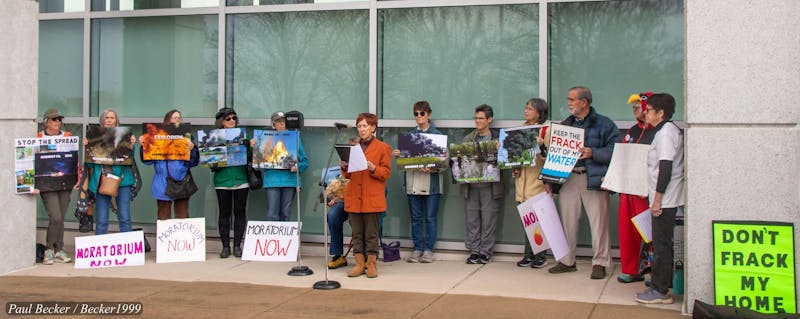
Billions of gallons were contaminated during the “extreme drought,” and for what? Cheap fuel. Only it’s not cheap. The price at the pump doesn’t include anything for the harm done in making that fuel or by burning it.
Wright’s critics see his views on global warming as a dangerous and self-serving misinterpretation of climate science. In their view, the fundamental role of fossil fuels in modern life is precisely the problem. Without a rapid shift to other energy sources, humanity risks undoing the types of progress Wright and his allies love to celebrate.

More and cheaper fossil fuel is the wrong direction to take. The damage caused by the use of fossil fuels and products made from them is conveniently externalized. Gas and oil are cheap because the user does not pay for the life-cycle cost, only for the initial production and distribution costs. And, in many hidden ways, the production cost is subsidized. Though he doesn’t mean it this way, true “climate realism” would assess the full life cycle cost of the fuel and include that as a penalty tax. But how do you price loss of coastline, extinction of species, wildfires, floods, and extreme weather? What’s the value of the casualties, what could compensate the child with asthma?
We aren’t even sure that humanity will survive what’s coming.
Senator Dave McCormick wrote an op-ed for the Washington Times that says, “The more I travel across the Commonwealth, the more convinced I become of the potential Pennsylvania has to guide America’s energy future. Philadelphia Gas Works is working to export LNG through the Port of Philadelphia. Penn America Energy and the Pennsylvania Building Trades are collaborating on a $7 billion project to build a new LNG export terminal along the Delaware River in Eddystone.”
It’s a bad idea for many reasons, both economic, global, and local. The reason energy interests want the terminal is to exploit foreign markets. Natural gas can be burned or made into plastics and chemicals. If burned, it contributes to global climate change. Plastics are polluting everything because we don’t have practical ways of recycling them. So whatever happens to the gas we liquify and sell, those who profit don’t pay the long-term costs; society does.
The social economics are bad too. Cheap fossil fuels compete with renewable, non-polluting energy. So their availability hinders the growth of sustainable energy production.
Then there are the pipelines. They create long, deep scars across the landscape and introduce the risk of leaks and disasters to the neighborhoods they traverse. The pumping stations vent substantial amounts of gas, and create other damage to the neighborhoods where they are located.
Last but not least is fracking. Overseas markets increase demand and bring higher prices, which encourages more drilling. We’ve extensively documented that nothing good comes to locals from fracking.
Senator McCormick is only telling half the story, the rosy half. He’s left it to the rest of us to tell the whole story and reveal the truth. You get all the facts right and still mislead people.
Follow the money.
The shale gas propaganda and disinformation folks are at it again. They claim that New York State families could get $27,000 a year in income from gas production if the state had not banned it. But what they don’t mention is the damage to the local environment, the health of the kids, not to mention the terrible cost of climate change. The massive cost of wildfires, epic weather events, and coastal flooding are all “externals” not to be discussed.
It’s not surprising that the Heritage Foundation is the source. They spawn many of the bad ideas that plague America today.
“Because the majority of Ohioans rely on groundwater for their drinking water, the threat of fracking byproducts, like radioactive brine, seeping into their drinking water supplies is not a small one. For example, in Athens County, fracking-produced brine has been found migrating over a mile away from its source since 2019 — inching its way toward groundwater drinking wells. The migratory activity of fracking byproducts makes fracking a statewide concern, including in Southwest Ohio.
“If just one aquifer is poisoned in Ohio from migrating radioactive gas and oil waste brine, it could affect the drinking water for tens of thousands people who rely on well water for drinking,” Zemper said.
Read more. Click the box below.

When you throw something away, where is “away?” The Westmoreland County Landfill is one “away” place where fracking waste is disposed of. But there is no away. The fluids leach out of the landfill and must be disposed of, or should we say disposed of again. WSL currently transports radioactive leachate and other chemically-laced liquid waste to treatment plants, but is seeking a new National Pollutant Discharge Elimination System (NPDES) permit to discharge liquid waste directly into the Monongahela River, via a pipeline. What could be wrong with that idea?


If you read the following article, you would think that fracking was a benign technical option. The problem with articles like this one should be obvious. It fails to address the history of things that can and do go wrong. Nor does it discuss the issue of sealing abandoned wells, which may be a practical impossibility once we punch holes through layers of rock. Steel rusts, concrete cracks, but the hole they attempt to seal with those materials is there forever. There is a long history with plenty of evidence that wells leak, and companies drill negligently, or exhaust their financial resources and fail to do as they should. The locals bear the long-term risks and costs. The lie is in what’s not said.
Players in the energy industry know how to skip on their cleanup obligations. Nobody wants to admit to it, but there are ways to game the system so that investors can take the money and leave behind a shell that has no capacity to clean up the mess they leave behind. “IBG/YBG” means “I’ll be gone and you’ll be gone when the bill comes due.” Those “good paying jobs” are gone too, such as they were.
The bill is coming sooner that expected.
Fires in California, violent weather elsewhere, floods, tornad
Here is a Reuters article about a government study that concludes fracking doesn’t necessarily hurt our water. The problem with such studies is always in the circumstances that were not considered. Keep in mind that the process involves punching a big hole through many different layers of strata, lining it with a big pipe and attempting to fill the gaps between pipe and strata with a cement-like substance. If successful, nothing leaks from the casing, and nothing can move up or down along the outside of the casing. The problem is that metal expands and contracts, the earth itself moves, and the pressures inside the pipe are extreme.
If you have ever had a wet basement, you know the problems inherent with holes in the ground and water. Once that hole has been punched it is there forever. Even if the well is properly sealed, the hole, the steel, the bentonite are all there to move and loosen and eventually leak. So be skeptical when you read reports like this:
The study does not consider the disposal of produced water.
