Author: rbshreve2

  • Let’s Be Skeptical

    Here is a Reuters article about a government study that concludes fracking doesn’t necessarily hurt our water. The problem with such studies is always in the circumstances that were not considered. Keep in mind that the process involves punching a big hole through many different layers of strata, lining it with a big pipe and attempting to fill the gaps between pipe and strata with a cement-like substance. If successful, nothing leaks from the casing, and nothing can move up or down along the outside of the casing. The problem is that metal expands and contracts, the earth itself moves, and the pressures inside the pipe are extreme.

    If you have ever had a wet basement, you know the problems inherent with holes in the ground and water. Once that hole has been punched it is there forever. Even if the well is properly sealed, the hole, the steel, the bentonite are all there to move and loosen and eventually leak. So be skeptical when you read reports like this:

    The study does not consider the disposal of produced water.

  • Scary Video

    The energy industry does not want us to focus on fossil fuel-induced global warming. They want us to perceive it as a distant and equivocal risk. But we should be alarmed by evidence like this:

    The NASA climate spiral visualization with labels in English and Celsius.

    The data shows us that global warming is real and is accelerating. Many things contribute to this vicious cycle, but one thing is certain: Abundant and cheap fossil energy is not helping. The invisible hand of the market place favors renewables only when renewables are cheaper than fossil fuel. (Read More)

    Let’s keep fossil fuels in the ground.

  • About those Fracking Earthquakes: It’s True

    Here’s the abstract of a study summarizing the reliability of findings concerning induced earthquakes. The evidence is credible.

    Claims of industrially induced seismicity vary from indisputable to unpersuasive and yet the veracity of industrial induction is vital for regulatory and operational practice. Assessment schemes have been developed in response to this need. We report here an initial assessment of the reliability of all globally known cases of proposed human-induced earthquakes and invite specialists on particular cases to refine these results. 1235 cases were assessed, requiring over 1000 h of work. From the 881 cases for which scorable evidence is available, we class 87% as ‘Confidently Induced’, 10% as ‘Probably Induced’, 2% as ‘Equivocal’ and < 1% as ‘Confidently Natural’. The most seismogenic activities are fracking, research, geothermal, water reservoir impoundment, conventional oil and gas. Least seismogenic activities are construction, deep penetrating bombs, coal bed methane. 354 cases (29%) lack enough information to be assessable. Future work could include applying data mining techniques including natural language processing and AI to uncover new evidence. Future best practice for rapid assessment of cases would ideally involve an independent panel of scientists who rapidly apply a questionnaire scheme, reach consensus, and inform a response.

    If you are the scholarly type, here is the PDF of the study from Nature.com.

  • Consequences

    New York State is trying to put the externalized costs of fossil fuel back on fossil energy producers. I don’t know if this legislation will be effective, but it sure focuses attention on the fact that “cheap” fossil energy is not truly cheap when the consequences of burning such fuels are considered.

    Pennsylvania, are you listening? A lot of people think fracking is a bad idea.

  • Wastewater Pipelines Unregulated

    What could possibly be wrong with leaving the safe operation of fracking wastewater pipelines to the folks who produce this toxic pollutant? Of course, that question is facetious. Unaddressed leaks reduce the amount of toxic waste for disposal. Legal remedies for damage are costly to achieve. So, the downside risk is limited if nobody is actively policing the operation of the pipeline. But the expenses of inspection and maintenance come right off the profit line of the operator. What could go wrong indeed!

  • Yes, Ban It

    We are happy to discover some good news about fracking: New Your State has banned CO2 fracking. There’s grumbling about lost economic opportunity, but keep in mind that all of the long-term costs are deferred and externalized. So it’s “other people’s money” that must deal with the health effects, the pollution, and the long chain of expenses related to climate change. The economic opportunity is an illusion cultivated by the energy lobby.

    Unfortunately, Pennsylvania has not awakened to the realities. Taxpayers subsidize fracking in so many hidden ways. Fracking does nothing good for locals or the planet.

  • Economic Benefits = Better Health?

    Forbs Magazine is not known for its advocacy of the common good. MediaBiasFactCheck.com says, “We … rate them Mostly Factual in reporting rather than High due to some misleading or false stories related to climate science.” So, we have some skepticism when a feature article suggests that the health problems attributed to fracking may be offset by the generalized benefits of fracking to local economies. It is a sorry state of affairs when the marginal economic benefit of fracking to locals is sufficient to improve their lives enough to show up as more and healthier babies.

    Nevertheless, here’s the story. You decide if this report is propaganda or a genuine reason to relax prohibitions on fracking.

  • Push Back!

    The PR firms and energy lobby work relentlessly to promote fracking. They have outsized influence on legislators, particularly at the state and local levels. When the rest of us are disengaged or complacent, bad things happen. Consider Ohio . . .

  • Seasonal Direct Action

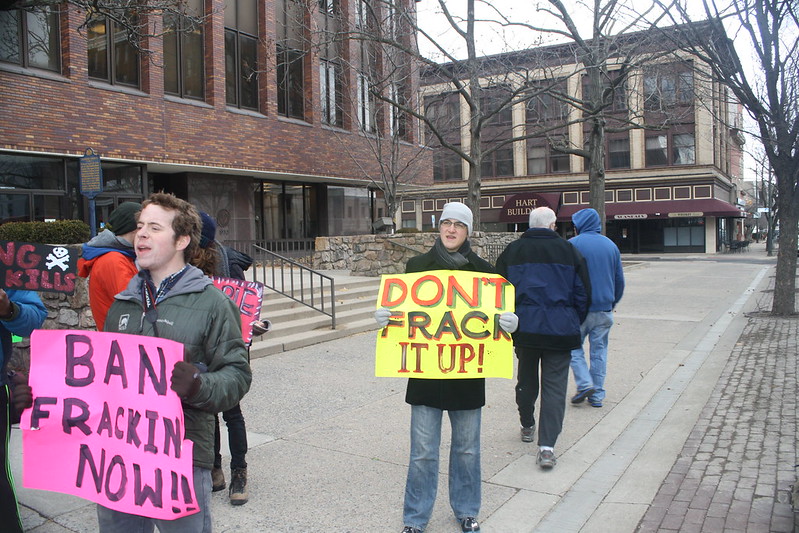
    “Direct action” is the term that is used to describe protests. Some are benign, like the caroling against fracking described below. Others are disruptive and seek to get in the way of business as usual to bring attention to the issue being protested. Direct actions become more extreme when the stakes are high and civil remedies for injustice are frustrated. Let us hope that direct action, even benign protest, is not necessary to prevent the excesses of the energy industry.

    This group will be caroling — but with pointed anti-fracking lyrics.

  • Greenpeace Gets In the Way

    Gutsy Greenpeace protesters in small craft blocked the way to port for a liquid natural gas tanker because the US producer uses fracking. Direct action like this is risky both physically and legally. The rest of us are heartened to see so many people organizing to make our world survivable in the long term and more healthy near-term.